Showing posts with label eBook. Show all posts

Saturday, October 31, 2015

Second Edition of Humbug! Price drop - only $2

The Second (eBook) Edition of Humbug! is now US$2 from:
Essentially it's as cheap as I can make it through Amazon without enrolling it in Kindle Direct Publishing Select, which you can only do if the book is exclusively on Amazon (which I'd never be prepared to do).


Sunday, January 27, 2013

Bad Faith

Other Terms and/or Related Concepts

Hypocrisy; Duplicity; Deception; Two faced.

Description

The advocate knowingly takes an unprincipled position or carries out an unprincipled action while disingenuously claiming to be motivated by principle.

Bad faith is similar in nature to many other types of humbug, but the key difference is that the advocate is knowingly acting in an unprincipled fashion - out of pure self-interest. Before accusing an advocate of bad faith, it is important to make a reasonable effort to ascertain that one is not merely impugning (their) motives.

Example

Daryl Mory is the spokesperson for an organisation that purports to provide education on the subject of vaccines. Mory's group is facing increased criticism and government scrutiny. He is giving an interview on a radio program in order to limit the negative press. The host, Nancy Mitchell, has just asserted that Mory's group is an anti-vaccination lobby and not interested in education. He responds by saying, "We are not, never have been, anti-vaccination. We are pro-information, pro-choice and a health safety watchdog."

Mitchell has prepared for a response like this. She responds, "I thought you might deny being a vaccine denier, so I did a bit of research. Here's what you've said in the past, and I quote:
  • Better hygiene and better nutrition is the reason why we've seen this decline. It has nothing to do with vaccination.
  • Vaccines don't work. Vaccines are dangerous.
  • Vaccines are instruments of death. Doctors, pharma companies, government officials are murderers. Vaccines are poisons."

Mory responds, "Well, you need to see those quotes in context. And some of them are quite old. We don't advocate one way or the other. We just want more research."

Mitchell lifts up a t-shirt from under the table and says, "Well I just received this t-shirt from your online store. On it is a picture of a crying child and an exaggerated oversized needle, with the slogan, Love them. Protect them. Never inject them. You sir, are a lying hypocrite."

Discussion

Bad Faith involves the adoption of a moral posture which is false. Other more simple descriptors may be used to describe such a posture - "duplicitous scumbag" comes to mind - but bad faith is a term which is worthwhile advancing for its precision of meaning, and emotional coolness. (Calling someone a duplicitous scumbag can be provocative, whereas claiming that they are acting in bad faith may be, or ought to be more tolerable.)

In the example above, Mory initially seems to be a genuine and reasonable person, attempting to provide the public with balanced information. As Mitchell quickly demonstrates, nothing could be further from the truth. Mory is a deliberately deceiving sciolist who has already made up his mind. As the quotes and t-shirt demonstrate, he rationalises his view with straw man arguments, motive impugning, paranoid conspiracy thinking and simple-minded certitude.

When a person is engaged in a debate or argument purely to win, such as a lawyer or debater, then bad faith is not an issue, even when he or she uses a sophisticated knowledge of fallacies to wrong-foot an opponent. However, when the same person maintains that his or her motives are pure - in the service of truth alone, then bad faith is involved.

Some more examples:
  • A journalist acts in bad faith when he or she claims to be reporting news - while in reality he or she creates news by provoking newsworthy incidents.
  • A social researcher acts in bad faith when he or she claims to be researching a topic in order to discover underlying reality - while in reality he or she discards and doesn't report results which don't support his or her cherished hypothesis.
  • A peace activist acts in bad faith when he or she expresses public anguish at the death of non-combatants while privately delighting in such casualties - as civilian deaths add weight to his or her position on armed conflict.
  • A Prime Minister acts in bad faith when they appoint someone who doesn't believe on god as Archbishop of Canterbury. The atheist Archbishop preaching (with apparent sincerity) from a pulpit about the resurrection and the life everlasting would also be acting in bad faith. (Well duh!)
  • An intergalactic space lord acts in bad faith when in order to catch some rebels he concocts a deal with one of their old acquaintances, who is now governor of a space colony they are due to arrive at; and then after capturing them he reneges and alters the terms of the deal. (One can only pray he doesn't alter it any further.)

Friday, January 11, 2013

Cultural Origins

Other Terms and/or Related Concepts

Appeal to tradition; argument from tradition; argumentum ad antiquitatem; appeal to antiquity; appeal to customs; our way (or their way) is best.


Description

When an advocate either promotes a "way of doing things" by citing its use in a particular culture or group, or denigrates a "way of doing things" by citing its use in a particular culture or group, he or she is making an appeal to cultural origins. An appeal to cultural origins is not in itself a valid way to resolve a contentious issue. Such an appeal is a fallacy and should always be challenged by the critical thinker.

Example

Chuck A. Hissyfit is a member of the Land Use Planning Committee set up as an advisory group to the Jumtup Local Council. The committee is having its inaugural meeting. On the agenda is the election of office bearers. Chuck states his position:
I think that we should operate as a collective. We shouldn't have office bearers. This western way has failed. We should meet together as the so-called Plains Indians of North America did. They simply sat and talked. They talked until consensus was reached. Their cultural values were more humane than ours and we should follow their example.


Comment

Somewhere in Chuck's rhetoric there may be a point. But he is not making it. He is appealing to cultural origins to both denigrate one way of doing things and to promote an alternative way of doing things. Such an appeal has no merit.

There may be some value in simply "sitting and talking" with a view to reaching a consensus. But that procedure needs to be argued on its merits, rather than accepted because some group or other at some time in the past under certain circumstances are said to have used the method. (Claims such as Chuck's often prove to be false anyway under close examination.)

In the present example, and if the other members of the Land Use Planning Committee were both fair-minded and skeptical, they might ask Chuck to explain in more detail just how his proposed meeting style would work in practice. They would also subject his explanation to critical inquiry and would not let him "get away with" rhetorical assertions. They would examine his proposal in the light of the terms of reference of the committee and practical issues such as the time available to members to meet. They might even agree with a trial of his approach on selected occasions. However such trials would involve a proper evaluation and comparison with other modes of decision-making. This methodology is bound to yield the right result. It is an approach to an inquiry that can trace its roots back as far as the ancient Greeks.

The cultural origins fallacy tends to be subject to whims and fashions. In the 19th and early 20th centuries, the transatlantic, industrial cultures were usually held up as positive examples for all of humanity. In the late 20th century, indigenous cultures were seen by many as worthy of emulation in all things. Critical thinkers, when confronted with a fashionable cultural origins fallacy can always "stir the pot" with counter-examples. Counter-examples are useful devices for challenging facile assumptions. For the sake of argument, consider the following rather simplistic example. An advocate suggests that people living in industrial societies should all adopt a personal totemic animal. Why? Because this was a common spiritual practice of many indigenous peoples. Skeptical participants in the discussion could then make a counter-suggestion to highlight the weakness in the advocate's proposition. They might suggest that within our cultural group, we should draw lots to determine who among us should be ritually murdered to propitiate the gods. Why? Because this was a common spiritual practice of many indigenous peoples.

In the context of the example given above, another member of the Land Use Planning Committee could suggest to Chuck that after they try the Plains Indians methods of consultation, they should give some other cultural methods a tryout during the life of the project. Perhaps Genghis Khan's approach to project management? Or a Viking approach to land acquisition? Or the Spanish Inquisition's approach to group cohesion and motivation?

Sunday, January 06, 2013

Impugning Motives

Other Terms and/or Related Concepts

Accusation that the opponent is: insincere; running a hidden agenda; "in denial".


Description

The advocate claims that the opponent has devious motives for making his or her case, or has unconscious motives which have led to a biased position on the issue under discussion. If the advocate claims that the opponent has devious motives, then the opponent stands accused of concealing the truth in order to win an argument. If the advocate claims unconscious motives on the part of the opponent, then the opponent is characterized as prey to his or her own emotions and unworthy of engaging in discussion.

Example

There is a staff meeting being held in a high school maths department. Jill Flypaper (the advocate) says: "I know the real reason why you are arguing the merits of voice recognition computer software Barry, you just want everyone to know that you are the expert and that you have more technical knowledge than the rest of us."

Comment

In this example, Jill is attempting to cast doubt on Barry's argument in favour of voice recognition software by claiming that Barry is just "showing off" his computer knowledge and doesn't really have good reasons for advocating voice recognition software per se. It is likely that Jill's deliberate intention is to convey the impression that Barry is insincere.

But it's also possible to interpret the comment as implying that Barry is sincere, but simply unaware of his "real" motives. While the accusation of insincerity or delusion may in fact be true, there is no way of knowing whether it is or isn't. Even if true, it is not a compelling reason for rejecting the purchase of voice-recognition software. At the most, it is a reason to be cautious about Barry's argument and for examining it carefully. In the final analysis, the case for purchasing the software needs to be decided on its merits, rather than dismissed out of hand because of supposed suspect motives.

The problem with the tactic of casting doubt on motives is that discussion between antagonists can degenerate into a spiral of accusation and counter-accusation. While witnesses to such arguments may form conclusions about the motives of the protagonists, and weigh one against another, they could be totally wrong. The most credible and apparently forthright people might be devious in the extreme. While a "shifty-looking" person might in fact be very honest.

The seeker after truth will be alert to, and recognise the use of, the fallacy of impugning motives and will draw attention to any attempt by an advocate to use it. They will point out that all behaviour and opinions are by definition motivated. Motives for any point of view can be assumed, but not the nature of those motives. Further, idle speculation about motives may be completely incorrect, and even if such speculation is correct, it does not usually clarify a debate or help determine the actual merits of a point of view.

In our view, anyone who engages in gratuitous speculation about motives is motivated by malice. Except the authors of this book. When we speculate about motives, we do so in a spirit of disinterested enquiry, and our speculations have proven in the past to be almost invariably correct.

Sunday, November 11, 2012

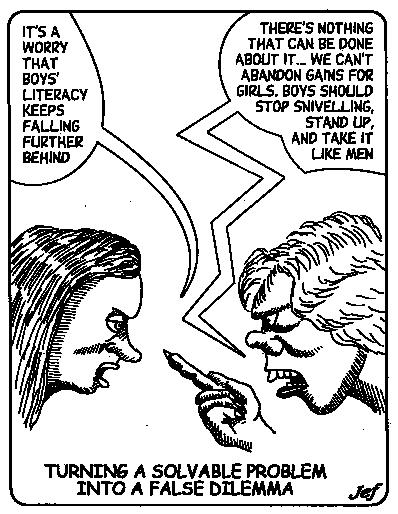
False Dilemma

Other Terms and/or Related Concepts

False linkage (of choices); concocted dilemma.

Podcast with further examples and extended commentary: Hunting Humbug 101: Episode 0012: False dichotomy and false dilemma (original episode).


Description

This is the error of portraying one choice as necessarily excluding another, even though there is no necessary connection. For example, an advocate might make the following statement: "They should solve world poverty before they try to put humans on Mars." While this may sound superficially plausible, the unstated and bizarre implication is that the advocate believes that if money were not expended on a Mars expedition, it would be diverted to the alleviation of poverty. This is clearly false.

Example

Dr Harry Oversteer is an epidemiologist with an interest in health statistics. He is having a conversation over dinner with Sally Butt, an old school friend. He remarks that men's health in general is in a much poorer state than the health of women in general. He points out that on almost all measures of mortality and morbidity - from suicide to heart disease - men fare significantly worse than women. He speculates on whether there should be more health promotion programs targeted specifically at men to address this anomaly.


Sally bristles and forcefully states the following: "It's taken the better part of a century to have women's health taken seriously by a male-dominated medical profession and public policymakers. If we embark on the course you suggest, women's health will take giant strides backwards."

Comment

What Sally is saying, without any evidence or compelling logical reason, is that a focus on men's health will necessarily lead to reduction of health services to women. This is clearly not a sound coupling of events. It is even possible that an increased focus on men's health will lead to better targeted health programs across the board. In the example given, a more reasonable response from Sally might be: "I can see the anomaly you've pointed out. The issue that needs to be addressed is how men's health outcomes can be improved, while at the same time ensuring that there aren't any adverse effects on women's health. We need a response which is acceptable to the whole community."


Sally's error arises from the supposition that there is a fixed health budget and that an increase in disbursement of funds to one group (i.e. men) necessarily results in less resources going to another group. Sally is right to alert Harry to the possibility that increased health promotion targeting men may lead to diminution of emphasis on women's programs. Her error is in asserting that it definitely will lead to this outcome.


Note that increases or decreases in the expenditure of scarce budgetary resources on government programs is a legitimate topic for political debate and social commentary. It is also true that the total "cake" available for allocations to programs is necessarily limited. At times, increasing budgetary allocations to program "X" may have a clear link to a decrease in budgetary allocations to program "Y". If this is the case, a genuine dilemma may be argued and the benefits of one program can be directly compared and contrasted to the other program. The seeker after truth will be able to distinguish a false dilemma from a genuine dilemma, and will make his or her case accordingly.

False Dichotomy

Other Terms and/or Related Concepts

Excluded middle; black-and-white reasoning; false dilemma; polarization of debate; forced choice.


Description

The advocate presents an issue as "black and white" when it is in reality "shades of grey". The reasoning put forward is unjustifiably "all or nothing" rather than subtle and measured. Debates about emotive issues such as euthanasia, GM foods, criminal justice, race relations etc., are often polarised in this way.

Example

During an election campaign, the incumbent Attorney-General, Frances Payne appears on television and makes his case for a review of current censorship laws affecting television broadcasting. She states that the review of the laws will be informed by broad community consultation. The interviewer (Barbra Twining) asks Mitchell Blarneypickle (President of the lobby group Smashing Hegemony In Television) to comment. He states: "There cannot be any censorship imposed by the State... anyone should be able to hear or see anything they like... any level of censorship is oppressive."

Comment

Mitchell is portraying the issue as censorship versus freedom of speech. He is attempting to put one issue up against the other and is hoping that his version of the issue prevails in the "contest". The flawed belief at the core of this strategy is that censorship is "all or nothing". In fact, the degree and nature of censorship which might be exercised in any society is subject to multiple variables. It is perfectly reasonable for example, for standards of what constitutes obscene or violent material to change over time along a continuum. The debate should be about how far along the continuum and in which direction the standards should shift - not on whether standards should be abandoned or raised to a level of complete repression.


In the present example, and if Barbra were an effective interviewer, she would challenge Mitchell on his "all-or-nothing" stance and either dismiss it as an unworthy contribution to the debate, or probe his position with examples which would be problematic. For example, she could ask her whether he would be in favour of live broadcasts of executions on free-to-air television, or the removal of doors and screens from public toilets. Such challenging examples would be an appropriate use of reductio ad absurdum by Barbra to point out that it would be ludicrous to apply Mitchell's views without qualification. Such a challenge might provoke Mitchell and lead to his indignant exit from the debate. But it's also possible that it would function as a reality check and cause him to modify his position and engage more effectively in the discussion. Either way, whether he leaves or moderates his position, the debate would be more fruitful.


Many LAME commentators (LAME - Look At Me Everybody are unhappy with ambiguity and complexity. Such individuals prefer to characterize an issue as "black or white", as they find dealing with nuanced shades of grey difficult and confusing, and more often than not, a threat to their position. The seeker after truth on the other hand, should not attempt to over-simplify any issue in order to bring it to a premature or unjustified resolution. It is much more acceptable in principle to decide that an issue has to remain unresolved, rather than oversimplifying and drawing the wrong conclusion.

Sunday, November 04, 2012

False Compromise

Other Terms and/or Related Concepts

Splitting the difference.


Description

The advocate asserts that because they do not understand or accept the opponent’s views, in fairness the two should agree to "split the difference" and arrive at a middle position. Such an approach to addressing an issue is more about mollifying the parties to a disagreement, rather than arriving at the truth of the matter.

Example

Jason Typeface and Wolfgang Von Volkswagen are senior bureaucrats in the Department of Justice. They have been engaged in a protracted discussion on the wording of a sentence in their jointly authored report on police "stop, question and search" powers. Jason has come to believe that police effectiveness in drug law enforcement is dependent on an absolute power to stop, question and search at their own discretion. Wolfgang believes that any questioning or search of suspects should only take place in the presence of legal representatives. They agree to split the difference and the final sentence reads: "Police may stop and search suspects at their own discretion, but any evidence so obtained cannot be used to prosecute the suspect.”

Comment

It is a safe assumption that neither Wolfgang nor Jason is satisfied with the compromise wording of the sentence. Neither of them actually believes that the stop, question and search policy they have come up with is the best one. Yet the reader of their report might make the assumption that the view expressed is what the authors believe to be the best policy. To avoid this misperception, Wolfgang and Jason should make it clear in the wording of their report that their conclusion is a compromise rather than a consensus view of the best position. Their compromise then would be open, rather than concealed.

There is a more intellectually respectable alternative to an open compromise. Wolfgang and Jason could be quite explicit about their disagreement and make it clear that they came to different conclusions as a result of their study. They could indicate that they have ”agreed to disagree” and they could state their separate conclusions. This would then leave it up to the decision-makers who read the report to decide on a final policy. This alternative would be the one favoured by the seeker after truth.

If they adopted this approach, both Jason and Wolfgang would preserve their integrity and they would be free to argue vigorously for their own favoured position. This approach is common in public documents such as reports of parliamentary enquiries, where a ”minority report” is commonly included when consensus cannot be reached.

Part of the problem with this issue is the emotional loading associated with the term compromise. In almost all contexts where the word is used, it carries either a positive or negative connotation. In the context of peace talks, industrial negotiations and the like, to compromise is to put aside ”selfish” considerations in the interests of a "fair" outcome. In the context of principled decision-making, a person who compromises is often seen as morally deficient.

Seekers after truth are always prepared to entertain the possibility of a compromise, but in doing so, they will be candid about differences, while putting differences aside in the interests of fostering a pragmatic and workable outcome.


Monday, October 01, 2012

False Cause; Correlation Error

Other Terms and/or Related Concepts

Post hoc ergo propter hoc (after this, therefore because of this); false association; superstitious belief.


Description

This fallacy is the result of the common human tendency to associate events which occur in sequence and to assume that there is a causal link. When an advocate claims that there is a causal relationship between two events, they need to give a plausible reason beyond simple association. If the advocate cannot do this they are probably in error. There are two possible "levels" of false association:

  • The relationship may simply be apparent rather than real (e.g. coincidence). In this case the error is a false cause because there is no causal relationship.
  • There may be an actual link, but the direction of cause and effect claimed by the advocate is incorrect. In this case the fallacy is correlation error because the cause and effect are reversed, or indirectly related.

Examples

  1. False Cause: Trixie Trendy-Chump has just opened up her new business card business – The Business Card Business. One week after opening, her total sales amounts to one pack of fifty cards for the local gravel merchant. She is talking to her husband Bevan Chump-Trendy about how she can improve sales. "I was reading recently about how Beijing is going through an economic boom. Now, everyone in China practices Feng Shui. They don't even think about setting up a shop without consulting a Feng Shui guru to make sure the energy lines of the store are conducive to business."
    Bevan responds: "So what you're saying, is that Feng Shui has made Beijing money, so why not you? Sounds good to me!"
  2. Correlation Error: Aaron Fibreglass is writing up his report on the link between self-esteem and obesity. He concludes: "There was a correlation of 0.8 between morbid obesity and low self-esteem. We need to raise the self-esteem of obese people to help them overcome their weight problem."

Comment

In the first example Trixie and Bevan assume there is a causal link between Feng Shui and economic prosperity. However, if Beijing is undergoing economic growth and its citizens happen to practice Feng Shui, it does not follow that Feng Shui is the cause of the economic growth. This relationship may simply be apparent rather than real – that is, a coincidence. To establish whether or not Feng Shui can influence economic prosperity, systematic tests would need to be conducted.

In fact at any one time, a great many cities around the world are going through economic growth. Few, if any city administrators give any consideration to Feng Shui. There are no doubt a great many other cites in China where Feng Shui is practiced. What is their economic activity like? The seeker after truth should always ask questions which go beyond mere association, and look for alternative possibilities.

In the second example, Aaron claims low self-esteem causes obesity. However on the evidence presented, causation could be in the opposite direction – obesity could be the cause of low self-esteem. Or both could be caused by a third, unidentified variable. To a skeptical scientist, such a strong correlation between obesity and low self-esteem is potentially of great interest, but a series of sophisticated follow-up studies would be needed to determine the nature of the correlation and the direction of causation.

False cause can have very serious consequences. For example, the false cause fallacy during the European dark ages led to the widespread belief that illness, famine and personal misfortune was caused by black magic and sorcery. Such beliefs led to "witch-hunts" (literally) and unfounded but widely believed accusations of sorcery. The absence of skepticism in communities wallowing in superstition led to the burning to death of innocents falsely accused of witchcraft. This still happens in the present day in societies that lack good governance and are dominated by superstition.

The false cause fallacy varies in the magnitude of the problems it causes. From the simple and harmless superstitions of sports people undertaking rituals or wearing a "lucky charm" in order to perform well, to the harm caused to seriously ill people when diverted from effective treatments to ineffective or harmful treatments by quacks or frauds.


Sunday, September 30, 2012

False Attribution

Other Terms and/or Related Concepts

Unreliable source; fabricated source (c.f. appeal to authority).


Description

This deceptive tactic involves an advocate appealing to a marginally relevant, irrelevant, unqualified, unidentified, biased or even non-existent source to support a claim. The advocate may in some cases have a "half-hearted" degree of faith in the alleged source (they may have a dim recollection of having read something somewhere about the topic), or the advocate may deliberately fake knowledge of a source which they know does not exist.

Example

Simon Murmurgut and Jenny Peristalsis are selling home-made herbal extracts at the local market. They have a sign at their stall advertising a "special slimming mixture". The main ingredient is paspalum juice. They are challenged by Kevin Jaded, a skeptical bystander. He says: "How do you know it works?"

Simon immediately responds: "There has been a recent study published in the Medical Journal of Patagonia which shows that eating four grams or more of paspalum each day results in the loss of up to 500 grams of body fat per fortnight."

Comment

If Simon did in fact read such an article, and if he is truthfully reporting the findings, he is not guilty of false attribution. However, if he only thinks that Jenny may have mentioned about a month or two ago that she had read somewhere in a South American journal that eating some paspalum each day results in the loss of some body fat, then he is guilty of false attribution. In this case, he is deliberately misleading Kevin about his own degree of certainty about the supposed "facts". If however, Simon is just inventing the reference, then he is guilty of the most reprehensible form of false attribution – deliberate deception through the citation of a fake source.

The deliberate or inadvertent fabrication of source information is a common feature of vigorous discussion. It is a tactic often used in desperation by advocates when they feel that the argument is about to be lost. The seeker after truth will often be assured by advocates that they have read some compelling facts about the topic under discussion – facts which unequivocally support the advocate’s position. The initial response of a seeker after truth to apparent dissembling of this kind should be a courteous request for a specific citation. This request should not be in the form of a provocative challenge, if the skeptic wishes to maintain a positive emotional climate as the discussion proceeds. In making the request, the point should be made that "going directly to the source" is always more reliable than a second-hand report.

Skeptical seekers after truth will not reject claims a priori. Nor will they accept claims a priori. They will reserve judgment on an issue and ask advocates for details of the source – with a view for reading it for themselves. Note that this request for a citation so that the skeptic can read the alleged information for themselves will not usually resolve the question on the spot, so the question may remain open. However, the more dedicated debunker may decide to pursue the issue beyond the particular discussion as a matter of principle. If the skeptical opponent subsequently finds out that false attribution has taken place, they could take the trouble to contact the evasive advocate (perhaps even several months after the initial discussion) and point out that the source cited doesn't exist, or the advocate's interpretation was in error.

In the day and age of internet enabled mobile devices such as mobile phones and tablets, made up on the spot false attributions will likely be easier to detect and a less effective form of humbug. As such, false attributions will likely become more elaborate. As the Wikipedia entry on false attribution now notes, devious and immoral frauds may even go as far as to create fake sources in order to cite them to support a claim.

(Note: if you are thorough you will no doubt attempt to verify the above reference to the Wikipedia entry on false attribution. It will almost certainly bear no resemblance to the citation above because of subsequent capricious editing. Check the revision history for 07:14, 28 April 2010 UTC to verify that this reference was valid at almost the exact time this updated section to the book was written - 07:37, 28 April 2010 UTC.)


Tuesday, September 04, 2012

False analogy

Other Terms and/or Related Concepts

Misuse of analogy; metaphor as argument; cliché thinking.


Description

A false analogy occurs when an advocate presents an example of a phenomenon and implies that the example either proves or compellingly illustrates something about another phenomenon. An example might be an argument that access to firearms should not be severely restricted, as access to kitchen knives is not severely restricted and yet, like firearms, they are sometimes used to kill innocent people. This analogy deliberately ignores critical differences between guns and kitchen knives. Such an example might have some value as a figurative analogy (the purpose of a figurative analogy is illustrative and metaphorical) but it is obviously flawed if it is intended as a literal analogy (advanced as a proof).

Example

Glenn Tropicana is an investment adviser and he is giving a sales pitch to a couple of prospective clients, Sheila and Dennis. Glenn is trying to persuade them to sign up for a regular monthly contribution to an investment scheme. The scheme may or may not be suspect – that is not the issue here.

During his spiel, Glenn states: "You know what happens with a steady drip of water into a bucket... before you know it the bucket's full. If you invest only $200 a month, in no time you will have a great nest-egg."

Dennis replies: "That's all very well, but what if there's a hole in the bucket that we don't know about?"

Comment

Glenn has met his match in Dennis. Glenn attempted to use his analogy of water dripping into a bucket as a compelling illustration of the wisdom of making a regular contribution to the scheme he is promoting. However Dennis is clearly a critical thinker and a skeptic. He recognised the fallacy in the analogy. When he recognised the fallacy he could simply have said: "Investments are a lot more complex than water dripping into a bucket – you'll need to present me with a better argument." However he chose to use Glenn's analogy against him by extending it, and introducing a confounding variable – the possibility of a leak in the bucket.

A common problem with the use of analogy to support an argument is that another analogy can usually be found to support the opposite position. For example, there are many metaphors, proverbs, clichĂ©s, traditional homespun sayings etc., which seemingly contradict each other. Consider a situation where someone may try to make a case for increasing the number of workers in a project team by citing the venerable proverb "many hands make light work". The proverb seems to be self-evidently true, and supports the notion that an increase in the size of the team would be a reasonable position to take. However someone else could use a plausible counter-proverb to support the opposite point of view, viz: "too many cooks spoil the broth". The latter proverb invokes a common experience of some large teams – separate agendas, miscommunication and a lack of coordination.

The fact that many proverbs are directly contradicted by other proverbs is an indication that reliance on proverbs or analogies in decision-making or resolution of issues is fraught with danger. We might (for example) be presented with an exciting once-in-a-lifetime business opportunity. We mull over the decision. A series of proverbs come to mind – opportunity only knocks once; make hay while the sun shines; seize the day; strike while the iron is hot. We invest. We go broke. Reflecting on out financial disaster, another set of proverbs comes to mind – look before you leap; act in haste, repent at leisure; haste makes waste; there's many a slip twixt the cup and the lip; don't count your chickens before they hatch.

All this isn't to say analogies are not of any use. Analogies work best when they are used to illustrate a more complex or abstract point. In particular if it can be related to something the audience is already familiar with. Analogies are frequently used in teaching, in science in particular. See for example:

Other examples

Educationalist David Ruenzel makes a good analogy (Gold Star Junkies. February 2000):

As critics have noted, it seems gratuitous to provide someone incentive to do what they already enjoy; in the parlance of behavioral studies, it's a case of "overjustification". Rewarding children who draw with markers, after all, is like rewarding kids with ice cream sundaes for watching television.

And a bad one:

To judge the necessarily variegated skills of students and teachers with an endless series of tests is as absurd as it is unfair-like putting huge scoreboards in classrooms and expecting adults and children to teach and learn under their imposing glare.

Neuroscientist Susan Greenfield seems to enjoy making public comments about social media without really engaging the organ she studies (Social networking sites "changing children's brains". The Telegraph. 24 February 2009):

I often wonder whether real conversation in real time may eventually give way to these sanitised and easier screen dialogues, in much the same way as killing, skinning and butchering an animal to eat has been replaced by the convenience of packages of meat on the supermarket shelf.


Wednesday, August 29, 2012

Factoid propagation

Other Terms and/or Related Concepts

Truisms; enshrined myths; false assumptions; taken-for-granted propositions.


Description

The advocate advances or states a mere proposition as though it is either: (a) an objectively established fact; or (b) so taken-for-granted by "reasonable people" that it is "beyond question". A key characteristic of a factoid is that it is so commonly assumed to be true, that it becomes "the Truth", when it is not actually established as true. The OED defines a "factoid" as: "Unreliable information which is repeated so often that it becomes accepted as fact."

Example

Dorothy Compost and Sheree Coachbolt are sitting companionably over coffee at a cafe on a Sunday morning. Dorothy reads aloud from a newspaper article: "Teams of trauma counsellors are volunteering to leave immediately for the Antarctic to counsel survivors of yesterday's rabid penguin attack which resulted in the deaths of 12 patrons of a "See @Sea!" cruise. The government has not yet agreed to fund the necessary charter flight."

Sheree says in response: "I'm not surprised they won't fund the charter, wouldn't it be better to spend the money on re-uniting survivors with their families?"

Dorothy bridles and retorts: "That's so insensitive. Everyone knows that post-traumatic stress disorder will be much worse and much more prolonged if victims aren't counselled immediately after the event by trained professionals."

Comment

The assumption that victims should be encouraged to talk about their feelings after a distressing event is a clear example of a "runaway factoid". The practice and belief has become widespread and commonly accepted in the absence of compelling evidence. There is evidence both for and against the practice, but the preponderance of recent evidence suggests that for many individuals, post-trauma counselling may be exactly the wrong thing to do.

In the example given, Dorothy could point out to Sheree that the notion of re-living trauma through dwelling on the event and talking about it seems counter-intuitive. She might venture an opinion that the idea of "bringing out" repressed trauma is based on discredited psycho-analytic dogma rather than evidence. Dorothy could further point out that, unless someone is diagnosed with a specific anxiety disorder such as post-traumatic stress, mental health is more likely to be underpinned by resilience – the capacity to "bounce back" and move on from trauma, rather than dwelling on it. Dorothy's claim that "everyone knows" is the element of her claim that invites a direct challenge and enthusiastic debunking.

The skeptic with iconoclastic tendencies is particularly attracted to factoids. Myths masquerading as facts often assume iconic or even sacrosanct status, and debunking enshrined myths can be an exhilarating blood-sport. A highly entertaining activity in itself, whatever the topic or subject area. Some domains of activity or types of publications are a treasure-trove of factoids ripe for debunking. These can include: desperately oversold curriculum innovations or educational practices; best-selling books on health or wellbeing; books by crusading historians, anthropologists or cultural gurus; any book by or about a LAME (Look At Me Everybody) public figure, and of course, newspapers.

Other examples

  • That water goes down drains clockwise in the northern hemisphere and anti clockwise in the southern. (It doesn't.)
  • That a person learns best when learning in their stated preferred learning style, such as visual, auditory or kinesthetic.
 

Saturday, August 18, 2012

Straw man

Other Terms and/or Related Concepts

False positioning; false target; aiming off; caricaturing a position; misrepresenting a position.


Description

The advocate attacks a weakened, exaggerated, over-simplified or otherwise false or distorted form of the opponent's argument rather than the real one. Commonly, the devious advocate presents a simplified caricature of his or her opponent's argument, then demolishes this "straw man", which is nothing more than an invention of the advocate.

Example

Harry Cackleberry has just taken the floor during a public debate on the teaching of evolution in schools. "These evolutionists would have us believe that our great-great-great grandparents were nothing more than monkeys. They say that one day, hundreds of thousands of years ago, a monkey gave birth to a human. Now I ask you ladies and gentlemen, how can a monkey give birth to a human?"

Jim Flakehammer, an evolutionary biologist from a research institute challenges Harry from the floor and says: "You are giving a false account of the evolutionary explanation of human origins. The way you put it, evolution is an easy target to be knocked down – the idea of a monkey giving birth to a human is quite ludicrous. However the real account given by evolutionary theorists is far harder to dismiss. What science actually says is that humans, monkeys and apes are related through a common ancestor from which all have evolved gradually by a process of natural selection."

Comment

Harry may genuinely believe that his simplistic version of evolution is the one held by evolutionary scientists. In which case he is committing the straw man error in ignorance. However it is often the case that the straw man error is a deliberate rhetorical device used by a dishonest advocate to "wrong-foot" an opponent.

For the purposes of analysis, we will assume that in the present case, Harry is being deliberately disingenuous. He is fully aware of the actual claims of evolutionary scientists. However he is uncertain of the strengths of his argument against the real theory of evolution. He therefore conceals his knowledge and advances a hackneyed caricature of the theory of evolution in order to create an easy target for scornful comments. His motives are to win the argument on the day, rather than to genuinely explore the issue.

A genuine seeker after truth does not resort to the construction of a straw man. If an opponent's argument is actually weak or incorrect, then there is no need for the advocate to misrepresent it in order to win. In the present example, Jim (the opponent) responds to Harry's subterfuge by pointing it out. Even if others in the room are unable to fully understand the actual account of human evolution given by science, they should at least be alerted to the fact that Harry (the advocate) is painting a false picture.

Note that the term "straw man" is at times used to mean something quite different to false positioning. This can sometimes lead to confusion. The alternate meaning is roughly equivalent to "bogeyman". That is, a scary apparition which is apparent rather than real – some imagined problem or consequence of an action which is conjured up by a party in a dispute to stop a proposed action. This usage is similar to the expression "paper tiger". The implication is that although a consequence of an action looks fierce (or difficult), in reality it is nothing to be concerned about.

Friday, August 17, 2012

Stacking the Deck

Other Terms and/or Related Concepts

Concealing counter-arguments, Stacking the Panel, False Balance

Stacking the deck cartoon

Description

The advocate deliberately conceals or avoids counter arguments to his or her own position in order to defeat the opponent. In such circumstances, the motive of the deck stacking advocate is to win the argument at all costs. He or she is not interested in arriving at a solution to a problem or the truth of the matter under discussion. Even when the deck stacker is aware of compelling information which would be of significant assistance to the opponent, his or her attitude is that it is up to the opponent to make the opposing case.

Example

Homner Stimson is arguing with his neighbour Nod Flinders about gun control. "People should be allowed to protect themselves. What if someone breaking into my house has a weapon? With a gun I'll be able to keep my family secure."

Nod replies: "I just think it would be too diddly-dangerous. If everyone had a gun there would be more and more shootings."

Homner changes tactics and attempts to shift the focus of the conversation: "Well we could say the same about swimming pools. About 500 children a year drown in the US, whereas under 200 are killed by guns. And, there are far less pools than guns. Why aren't you calling for swimming pools to be banned?"

Comment

In this example, Nod points out a potential problem with Homner's initial argument. With more people owning guns, it seems likely that there would be more shootings. Homner thinks about this and sees that Nod may have a point. His tactic is to move the goalposts and make an analogy with swimming pools. He then stacks the deck by only referring to data related to children.

The total number of (non-suicidal) gun related deaths in the US is over 12000 a year. Homner knows full well that Nod's argument applies to gun control in all areas of society, not just where children might have access to guns. He deliberately limits the discussion to an area where he feels his argument has a chance. He "stacks the deck" in his favour.

His comparison also starts to shift the focus of conversation away from guns. Swimming pools have now become a distractor. The number of deaths from swimming pools is completely irrelevant from he number of deaths from guns. All this really does, if anything, is establish the argument for much stricter regulations on swimming pool safety, and teaching children to swim from the earliest age possible.

In the present example, and if Nod were a reasonable person, he would find many weak points in Homner's position, despite the deck stacking. However it is also important to address the deck stacking per se. The seeker after truth in such a situation would make explicit reference to stacking the deck and would repudiate the use of such a tactic whenever it is used in argument.

Other examples

False balance is a related concept to stacking the deck. It is an accepted truism that there are "two sides to every story". As a consequence, TV reports often feel the need to find an individual who holds the opposite view of the main topic of the report. They do this in the name of "balance". In many cases this is legitimate and fair minded. However, in a report on (say) childhood immunisation rates, the cranks are often given equal or even more time than is representative of their view, thus providing the report a false balance. It gives the appearance of a real controversy where there is none. Giving the actual balanced view would result in the expert being given (say) two minutes of screen time, and the anti-vaxer a one second clip of an outtake in which they didn't realize they were being recorded and are scratching themselves somewhere inappropriate.

It should be noted that the term stacking the deck is sometimes misapplied to situations where the composition of a discussion panel is biased in favour of one side of a controversial issue. Producers and presenters of radio and television discussion programs rarely take the trouble to ensure that panel members or interviewees are numerically equal, or equal in terms of their ability to present a cogent argument. While the expression "stacking the deck" seems like an appropriate description for such practices, its use might lead to confusion with the standard usage. A better expression might be "stacking the panel" or "panel selection bias".

We regard "stacking the panel" as a reprehensible and pernicious practice which leads to ungovernable bias in television and radio current affairs journalism. In our view, the only corrective to this bias would be to give us our own program and to let us have a free hand in choosing the on-air talent.

Wednesday, August 15, 2012

Special Pleading

Other Terms and/or Related Concepts


Claiming to have special insights or superior sensitivity; asserting connoisseurship; Immunised Hypothesis


Description


This fallacy occurs when an advocate claims that he or she has a special insight into the topic under discussion. Further, (by implication or explicit claim) the opponent cannot possibly comprehend the subtleties or complexities of the issue because he or she is unable to attain the level of insight available to the advocate. Underlying such special pleading or claims to deep insight or empathy is a presumption that the views of the advocate cannot be evaluated because the opponent lacks the capacity to make any valid judgement. All such claims should be treated with deep skepticism.

Another variant of the fallacy Special Pleading occurs when an advocate, faced with contradictory evidence, introduces caveats, double standards and exceptions to the rule, in order to maintain (and redefine) their position. See Immunised Hypothesis for a detailed explanation.

Example


Toby Nightlight is writing a letter to the local newspaper. He is incensed at a column in the paper written by a local medical practitioner, Dr Sally Sodfreud. The basic theme of Sally's article is that violence associated with alcohol abuse in the local indigenous community has increased enormously over the last year. She attributes this to the construction of a "wet canteen" at the community centre just over a year ago.

Toby's first sentence reads as follows: "As an aboriginal man, I know what damage has been done by paternalism towards aborigines in the past. Dr Sodfreud might be well meaning, but she doesn't have a clue... [if she were to] walk a mile in my shoes, she would understand just how insulting her suggestion is."

Comment


In the example given, the wording of Toby's opening sentence appears to be attempting to establish from the outset that his views on the issue of alcohol use are unchallengeable. Seekers after truth would place little weight on such a claim per se. They would examine the rest of the letter and consider any of Toby's claimed insights on their own merits. Reasoned justification of views would be needed before they could be considered to be credible. After all, Sally could herself claim special insights not available to Toby. As a local GP she would no doubt be attending to injuries inflicted by alcohol-fuelled violence and she would be talking to the victims.

Special pleading is a commonplace feature of newspaper opinion columns, political speeches, television panel discussions and the like. People who seek to air their convictions in such public forums are usually attempting to influence public policy. Often there is also an attempt at self-aggrandizement through moral and intellectual posturing. In such circumstances, and when the "public advocates" fail to mount a well-researched, intelligent argument in favour of their convictions, they often fall back on a range of shallow rhetorical devices, including special pleading.

Statements along the following lines are examples of special pleading: "You don't understand because you are: a man, a woman, an aborigine, a whitefella; or you are ignorant, a philistine, insensitive, lack cultural awareness or intellectual ability, spirituality etc. If you were like me or had my fine sensibilities you could not help but agree with me."

Special pleading can take many forms and can be employed in a wide variety of contexts. If for example, the judge at an art show is unable to convincingly explain her choice of a prize-winner, she may fall back on transparent and self-serving special pleading by way of justification. We here quote verbatim some examples of the genre from an actual judge at an exhibition (attended by Jef). The judge is commenting on the first prize-winner: "It speaks to me... it is perhaps... I sense that the artist is challenging and inviting self-examination... the viewer needs to be attuned to minimalism... only seems like a four-year old could do it... that is perhaps a figure.... perhaps looking down... perhaps in torment." Perhaps the judge is an arts wanker?

A variant of special pleading is synonymous with immunised hypothesis. That is, the advocate makes a claim that in practice (or even in theory) cannot be falsified. When evidence is brought to their attention which contradicts their claim, they continue to add on ad hoc explanations; generally refusing to even entertain the idea that their original claim may actually be false.

Tuesday, August 14, 2012

Slippery Slope

Other Terms and/or Related Concepts

Thin end of the wedge; Trojan horse.

Slippery Slope Cartoon

Description

The slippery slope fallacy assumes without evidence that if we take a particular step which in itself doesn’t cause a problem, it is nevertheless the first in a series of steps that will lead inevitably to some undesired outcome. This fallacy in reasoning is often called the “thin end of the wedge” argument. An example might be the view that if marijuana is decriminalized, then this will inevitably lead to decriminalization of harder drugs. Or: “If we allow simulated depictions of sex on TV after 9.30pm, it won’t be long before such things are depicted early in the evening when young children are watching.”

While this view is technically flawed (not based on direct evidence), dismissing such concerns as necessarily without foundation would be problematic, as experience suggests that communities, nation-states or civilizations may sometimes be incapable of recognizing and responding in a timely way to incremental, adverse change.

Example

Gene Toadstrangler is a spokesperson on public affairs for the Church of Chastisement. He has been asked by the editor of The Daily Drumbeat, a small regional newspaper, to write an article on a Bill before state Parliament on the Rights of the Child (Safety and Security). Among his remarks is the following statement:

At the moment, the proposed legislation states that parents are not allowed to assault their children with a heavy object… this is something we would all agree with. But the problem with such legislation is that it won’t stop there… once this is passed, it will give impetus to ‘do-gooders’ who will be encouraged to remove all rights to parents to discipline their children.

Comment

Gene is in the paradoxical position here of seeking to argue against a proposition that he actually believes in. He believes that parents should not be allowed to belabour children with a solid object, but he doesn’t want the legislation because legislation which might follow might go too far.

Gene would be well advised to clearly define for himself just what level of punishment should be available to parents in chastising children. He should then develop as clear a case as possible for reserving the right to punish at that level. Following this, he could then point out that although the current legislation is acceptable to him, there is a widely recognised tendency for “crossing lines drawn in the sand”. He could argue that the community as a whole should be alert to possible further shifts in the levels of correction available to parents. When such a shift occurs, he can then vigorously oppose that further shift from a credible standpoint.

The slippery slope is a widely recognised and documented fallacy in informal logic. However, it is often the case that accusations by an opponent that the advocate is employing the slippery slope fallacy are unwarranted.

Sometimes individuals who simply wish to halt an incremental change at a particular point will present a rational case for their position. For example, an advocate may argue against cloning as a solution for human infertility on the grounds that cloning is itself undesirable for various reasons. Further, that once the technology for safe and effective human cloning is developed, elective cloning is likely to follow. An accusation that the advocate has made unjustified use of the slippery slope argument in the latter proposition may not be warranted. If (for example) the advocate can illustrate and support his or her case with parallel examples where technological developments have outpaced ethical controls, then he or she is likely to be a seeker after truth rather than an emotionally driven alarmist.

On the other hand, when people who lack the mature judgement of the authors venture onto a slippery slope, they will inevitably wallow in ever-more bizarre misconceptions and fallacious reasoning until we end up with nothing but gibberish – and finally, the complete destruction of civilization as we know it.

Monday, August 13, 2012

Single Cause

Other Terms and/or Related Concepts

Reductive fallacy; over-simplification; Over-generalisation

Single Cause cartoon

Description

Single cause fallacies occur when a person assumes that there is only one cause of a complex problem. For example, an advocate might solely attribute youth homelessness to child abuse within dysfunctional families. Other advocates might attribute it to unemployment. Still others might attribute it to lack of discipline in schools and the home. It is unlikely that only one of these factors is involved, and the solution of such a complex problem requires looking beyond simple causes, no matter how dear to the heart of the particular advocate a particular cause may be.

Example

Nelly Impacted-Molar is giving a lecture to adult students enrolled in a community-based self-development program on substance abuse. She answers a question from Jake Loosely. Jake has just asked her why some drinkers become alcoholics or problem drinkers and some don’t. She states: “The only reason a social drinker progresses from occasional drinking to full-blown alcoholism is low self esteem. This is why alcohol is such a problem in remote rural communities. These communities suffer from collective low self esteem brought about by poverty and isolation.”

Comment

It may or may not be the case that low self-esteem increases the likelihood of problem drinking, but Nelly is claiming it is the sole reason for the problem. This is unlikely since alcoholics are present in all strata of society and exhibit all levels of personal achievement. She doesn’t cite research to back her claim and her audience is likely to have anecdotal knowledge about cases of alcoholism that don’t fit her sweeping claim of a single cause.

In such circumstances, the audience is entitled to be skeptical, to challenge her statement and to insist on hearing evidence that supports her view. Note the particular words she uses in her statement — “the only reason” — indicate clearly that her error is the single cause fallacy, or over-simplification. However, in this example the single cause fallacy is likely to be further compounded with yet another fallacy – false cause; correlation error. It may well be possible for example, that low self-esteem is a consequence of alcoholism rather than one of the causes.

Nelly’s error is not a trivial one. If she were to undertake a community based program to address alcoholism in an isolated and impoverished rural setting, and if she makes the wrong assumption about the cause of alcoholism, her remedial program might compound the problem, rather than address it effectively.

The single cause fallacy is widespread and commonplace. The single cause of this is due to a tendency of people to latch on to relatively straightforward solutions to problems, even if the problem is complex.

On further consideration, other factors may be at work. Over generalisation, in particular, extrapolating one’s own personal experience as a universal experience, can lead to making a single cause fallacy. It is also easier to fool ourselves into believing that we comprehend a complex problem if it is artificially stripped of its complexities. Unfortunately, to pretend a complex problem is simple is delusional – a retreat from reality rather than an engagement with reality. Seekers after truth will seek the truth, in all its messy complexity. They will metaphorically roll up their sleeves and do what is necessary to address the problem, no matter how complex or difficult it may be.


Thursday, July 12, 2012

Simple-Minded Certitude

Other Terms and/or Related Concepts

Intransigence; studied / willful / implacable / indefatigable ignorance; "denial"; bovine complacency; defense by dogma; rationalisation; cognitive dissonance.

Description

Simple-Minded Certitude is the preferred descriptor in this book for a habit of mind which is commonly labelled intransigence. Simple-Minded Certitude is an unshakeable belief that will remain unchanged even when indisputable evidence is presented which demonstrates the belief to be false. "Simple-minded" is intended to convey the voluntary use of simplistic reasoning, rather than an "organic" limitation of intellectual capacity. (It is not uncommon for otherwise intelligent individuals to be simple-minded in their approach to a particular topic.)

It is a temptation to accuse someone of intransigence or Simple-Minded Certitude simply because they disagree with us. But this accusation should not be used lightly. If it is used too lightly, then its utility as a legitimate criticism is compromised.

True Simple-Minded Certitude occurs when an advocate has a characteristic mindset that simply refuses to entertain the possibility of being wrong on a matter of fact. Or the advocate, in effect, rules out any possibility of being persuaded to another opinion, whatever the evidence presented by the opponent. Intransigent advocates are deaf to information which might disturb their state of comfortable, implacable ignorance.

Example

Ramone Pust-Yool and Debbie Pust-Yool are getting to know each other after a whirlwind courtship and marriage. Debbie has just disclosed the fact that she would like to have three children. She also states: "…and I'll be giving them natural homeopathic vaccinations, not the poison the government wants us to jab into children."

Ramone is somewhat alarmed at this, and states: "But homeopathy is just 'magic water'? It's 'natural' because it's just water. They dilute the original mixture so many times it doesn't have even one molecule of any actual ingredients. And vaccinations are arguably the greatest and safest medical intervention in human history? We've essentially eliminated a whole host of horrible diseases. Now that people have forgotten what those deceases were like and stopped vaccinating, we risk them coming back and in fact, this has already happened."

Debbie bridles and loudly proclaims: "I don't care what the government and doctors say, they're just in the pocket of big pharma. I know that vaccines are bad and homeopathy is the way to go thanks to the work of people like Jane McCarry."

"Jane McCarry? The ex model-slash-actor? That's your source of information?"

Comment

Leaving aside the questions of whether or not government and doctors are all involved in an elaborate conspiracy on the behalf of big pharmaceutical companies to poison our children; and whether homeopathy has any efficacy as a medical intervention beyond a placebo; and whether the views of a model-slash-actor on public health should be taken seriously, let's consider Debbie's Simple-Minded Certitude. (We will leave these questions aside as the answers are, respectively, "No they aren't", "No it doesn't", and "Surely you're joking?".)

Debbie is exhibiting a defensive stance which indicates that she is preparing to enter a state of Simple-Minded Certitude. Her initial statement above is extravagant and emphatic. It seems to be intransigent. If she continues in that vein, she would clearly be exhibiting the fallacy of Simple-Minded Certitude. If, however, her statement is merely an immediate emotional over-reaction, and she then becomes more open-minded and reasonable as the discussion proceeds, she is not fundamentally intransigent.

Ramone's best strategy in the face of Debbie's apparent over-reaction would be to respond with "sweet reason". As a critical thinker, he would focus on the issue without raising the emotional temperature. His response would be mild and measured. He might think: "Uh-oh, I've married a crazed rage-aholic." But he wouldn't say it. He would say something like: "Well, I'd like to look into it... it's a decision for both of us... we should always put the health of our children first."

Pure, persistent Simple-Minded Certitude in the face of incontrovertible contrary evidence is a characteristic of the less reflective and intellectually respectable professions to be found in our community – such as clairvoyants, opinion columnists and celebrities. Consider for example, the common situation where a famous actor (who also happens to believe that they are clairvoyant) decides to write an opinion column and advocates a position in the following form: "If the government does X, then Y will surely follow." In time, the government does X, but Y does not in fact follow. In such circumstances, the more opinionated and simple-minded the advocate is, the more unlikely it is they would admit to error. They will characteristically dissemble, squirm and avoid at all costs the admission "I was wrong".


Monday, July 02, 2012

Self-Defeating Argument

Other terms and/or Related Concepts

Self-refuting idea; Self-refuting sentence; Self-contradiction; Tautology; Begging the Question; Circular reasoning

Description

A Self-Defeating Argument is one that is internally inconsistent (self-contradictory) and as such, by definition is false (and therefore meaningless). The proponent has inadvertently set up a paradoxical circular argument; if the conclusion is accepted as true, the premises must be false (which therefore means the conclusion must actually be false, which then could mean the premises are true... ad infinitum).

A classic example is the liar paradox. Consider the following:

The following sentence is false. The preceding sentence is true.

If we accept the first sentence, then we must conclude the second sentence is false. However, in doing this, we invalidate the "truthfulness" of the first sentence, but if that’s the case...

Example

Dani Nigher is arguing with her friend Con Senses about climate change.

"Global warming just can't happen. Think about it. They say the overall temperature of the Earth's oceans will increase. What happens to the volume of water when it gets hotter? It increases! An increase in ocean levels will mean an increase in ocean volume and as such, ocean surface area. But, if the ocean surface area increases, we'll also get, as a consequence, more evaporation.

More evaporation means heat gets taken away from the surface, and more importantly, more cloud cover, which will stop sunlight reaching the surface of the Earth. More light will be reflected into space. That is, the increase in evaporation will actually cause cooling, and cancel out global warming from the greenhouse effect!"

Comment

Ignoring all other flaws on Dani's argument, we will just focus on her logic. If we believe the conclusion, that excessive evaporation will cancel out warming by greenhouse gases, then how did the ocean surface area increase? (A prediction of global warming is the melting of polar ice caps, and thermal expansion of the oceans, will cause a rise in ocean levels.) The conclusion contradicts the premise, so is invalid. By definition the premise must be accepted as true for the conclusion to be valid. But if the conclusion contradicts the premise, we have a Self-Defeating Argument.

Now, of course, giving Dani the benefit of the doubt, we could rephrase her idea and propose a reasonable, non-contradictory hypothesis. For example, the increase in ocean surface area could damp climate change causing a lag in warming. Or, the increase in surface area could be involved in a cycle, that means periodically the temperature goes up, then goes down, then goes up.... and so on. Whatever the case, it won't be a simple cancellation.

Without having consulted any literature on climate change, or bothering to talk to even a single climate scientist, one still feels fairly safe in presuming variables, such as the increase in surface area of oceans and consequent evaporation, is something that (among thousands of other variables) scientists do account for.


Thursday, June 28, 2012

Red Herring

Other Terms and/or Related Concepts

Moving the goalposts; the Chewbacca Defense.

Description

The advocate deliberately introduces an irrelevant topic into a discussion or debate in order to divert attention away from the topic under consideration. The Red Herring is similar to Moving the Goalposts, in that the advocate is attempting to change the focus of the conversation. What makes Red Herrings different is the employment of outright non-sequiturs.

Examples

1. Newton Mattburt was accused of assaulting his former girlfriend Sacha Wellbroke. His lawyer spoke on his behalf outside the court: "Mr. Mattburt pleaded not guilty to the charges and will defend himself vigorously. Let's get some perspective," Mattburt’s solicitor went on to say: "Ninety people died in Iraqastan today, most of them kids. This is a very minor matter."

2. In the South Park episode “Chef Aid”, Lawyer Johnnie Cochran is representing a record label who is suing the character Chef over the intellectual property of the song "Stinky Britches”. He starts talking about Chewbacca (from the Star Wars movies), referring to the fact that Chewbacca is a Wookiee from the planet Kashyyyk who lives on the planet Endor (he actually doesn't). But as Cochran points out, this does not make sense:

Cochran: Why would a Wookiee, an eight-foot tall Wookiee, want to live on Endor, with a bunch of two-foot tall Ewoks? That does not make sense! But more important, you have to ask yourself: What does this have to do with this case? Nothing. Ladies and gentlemen, it has nothing to do with this case! It does not make sense! Look at me. I'm a lawyer defending a major record company, and I'm talkin' about Chewbacca! Does that make sense? Ladies and gentlemen, I am not making any sense! None of this makes sense!

And so you have to remember, when you're in that jury room deliberatin' and conjugatin' the Emancipation Proclamation, [approaches and softens] does it make sense? No! Ladies and gentlemen of this supposed jury, it does not make sense! If Chewbacca lives on Endor, you must acquit! The defense rests."

(South Park 1998, Season 2, Episode 14)

Comment

The kind of Non Sequitur used by Mattburt’s lawyer in the first example is a Red Herring. It is a deliberate attempt to divert attention away from the real issue under consideration - that Mattburt (allegedly) beat his (now ex) girlfriend. Most of us would agree that 90 people dying in a war zone is, in the grand scheme of things, worse than one person being assaulted. However, this has nothing to do with the case.

In the second example we have an extreme version of the Red Herring Fallacy called the "Chewbacca Defense" - coined in the animated series South Park. South Park satirised the closing argument of the attorney (Johnnie Cochran) defending O.J. Simpson at his murder trial. The Chewbacca Defense is more extreme that a "standard" Red Herring. It is a series of bizarre non-sequiturs whose only purpose is to confuse an opponent.


Thursday, June 21, 2012

Red Flag Faux Pas

Other Terms and/or Related Concepts

Specious allegations of fallacy; Fallacy Abuse.

Description

The advocate is overly quick to claim an opponent has made a fallacy when in fact the opponent has not.

Example

Religious apologist Bjorn Belleeber, writing in the peer reviewed journal Theological Ratiocinator, is critiquing an argument forwarded in a paper from the prior edition.

Begging the Question is a fallacy that occurs when a disputant uses his conclusion as one of the premises employed to establish his conclusion. In his paper, Dawkitch asserts that: "Over time, as we progress through history, our society gets older and wiser and our view of the world and everything in it becomes less and less superstitious and more realistic. We stop believing in spirits, demons and the undead. Our model becomes realistic; over time, we update it with correct information from the real world." How can Dawkitch know this is true before all the evidence is in? Dawkitch begs the question and assumes that his conclusion is true by restating the premise.

Comment

"Red flags" are the particular things one looks out for that could mean a fallacy is in play. For example, gratuitous insults and slurs on an opponent's character could mean an Ad Hominem attack. "Faux pas" comes from French, meaning “false step”. In English (and French) faux pas are embarrassing violations of social norms. So in this sense a Red Flag Faux Pas is the embarrassing mistake of accusing someone of making a fallacy, when in fact they have not.

Just because a red flag has caught one's attention, in order to avoid taking a "false step", one shouldn't be overly hasty in claiming a fallacy has been committed. Is the red flag the basis of an argument? If so, then it is likely a fallacy is being made. If the red flag is an addendum to an argument or point, or simply not part of an argument, then it may not be fallacious (it might simply be impolite and/or irrelevant).

The example above is not Begging the Question, as Belleeber claims. There is no premise in Dawkitch’s statement. There is also no conclusion. Ergo, it’s not Begging the Question. It is simply an assertion. One can choose to agree or disagree with it, but it’s not Begging the Question. Begging the Question would be more like:

Over time, as we progress through history, our society gets older and wiser and our view of the world and everything in it becomes less and less superstitious and more realistic. We stop believing in spirits, demons and the undead. This is because our model becomes realistic over time, we update it with correct information from the real world and stop relying on supernatural explanations for unexplained phenomena.

Note the introduction of the word "because". This clearly shows this is the sentence that attempts to justify the claim in the initial section. But of course, it’s simply the initial claim reworded to sound like a justification. Now it is a Question Begging argument. Dawkitch should only be accused of making an unsupported assertion. This in itself could be argued is error enough. Every sentence simply repeats this assertion in a different manner for more emphasis.

Making a Red Flag Faux Pas is understandable. In cases such as the example above, the continued repetition of the same point is easily mistaken for a Question Begging argument, just as insulting somebody is easily assumed to be an Ad Hominem attack. The key to identifying a fallacy is careful consideration of the structure of the argument or position. Is is formulated as an argument? If not, it is more than likely a naked assertion, which can be dismissed in any case.