Showing posts with label Gibberish. Show all posts

Friday, December 28, 2012

Gibberish

Other Terms and/or Related Concepts

Obfuscation; gobbledegook; nonsense; drivel; academic English; jargon.

Description

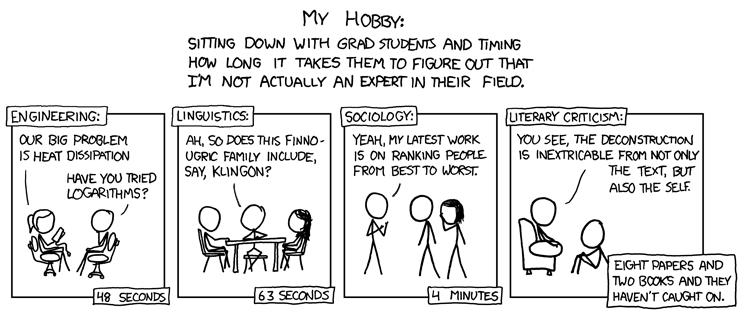
Gibberish is an argument or assertion that is so flawed in its presentation that it is essentially meaningless. When the advocate has not advanced an intelligible argument, a considered response from the opponent is a waste of time.

Gibberish is quite common in academic literature. Stephen Murray-Smith, in his book Right Words: A Guide to English Usage in Australia is scathing in his definition of this particular form of gibberish:
Academic English is a horrible corrupt dialect of the English language, used by teachers in tertiary institutions in order to sound cleverer than they really are and thus to win promotion, power and money.

Example

The prevalence of gibberish in academic literature was also a major concern of Alan Sokal and Jean Bricmont. In their book Intellectual Impostures, they give many examples from the social sciences in particular. One is quoted here by way of illustration:
The time of this instant without duration is 'exposure time', be it over or under exposure. Its photographic and cinematographic technologies already predicted the existence and the time of a continuum stripped of all physical dimensions, in which the quantum of energetic action and the punctum of cinematic observation have suddenly become the last vestiges of a vanished morphological reality.

Comment

Advocates who use gibberish may be unaware of just how unintelligible their language is to the listener or reader. Or they may be deliberately using gibberish to obscure the issue and to avoid any possible challenge. Whether gibberish is the result of stupidity or duplicity, skeptics and critical thinkers will not be cowed by their own lack of comprehension. They are entitled to ask for clarification, and if appropriate, to draw attention to the flawed use of language.

The seeker after truth's initial response to gibberish in a verbal exchange will be courteous and pragmatic, viz: "What are you saying?...Could you explain what you mean?... Could you give an example?...You need to put your argument with greater clarity."

If mild and courteous requests for clarification are ignored, more emphatic requests might be necessary, viz: "Could you please come to the point?...I can't tell whether your position has any merit because I have no idea what you are saying... Complex ideas need to be expressed in simple, direct language... I think what you just said is essentially meaningless, but I can't tell for sure because your explanation was so garbled..."

If this still has no effect, perhaps a more confrontational approach is in order: "How can I tell the difference between what you are saying and complete horse manure?"

Note that it is critically important to distinguish between unnecessary gibberish and the use of uncommon words to convey complex ideas with precision. There is nothing wrong with an advocate using an advanced vocabulary when this is necessary to communicate an exact meaning.

The problem of obfuscation arises when an esoteric vocabulary is used in ignorance, with little or no regard for meaning, or for the effect on the listener or reader. The expansion of vocabulary to enhance the quality and precision of written expression or speech is laudable. However when an advocate engages in the indiscriminate use of meaningless words, or uses meaningful words meaninglessly, the practice should be treated with the scorn, mockery and censure it deserves.

Tuesday, July 14, 2009

WHY I DISTRUST ACADEMICS

You only have to work among academics for a short time before you become aware of how biased they can be. Treasured theories will not be discarded lightly in the face of data which challenges those treasured theories.

Occasionally however, this issue can be thrown into stark relief. I was once in the privileged position of being able to talk to the "subject" of a colleague's study after the study had been published.

There was an astonishing mismatch between the study as reported and the subject's recollection of what happened during the study. I have no doubt the subject's version was the correct one.

I still can't decide whether the researcher's distortions were the result of stupidity or academic fraud. Either is a plausible hypothesis.

There is however no doubt that the research published by the academic concerned is worthless. Insiders know this, but the public and policy makers could be seriously misled by this wacky fantasist.

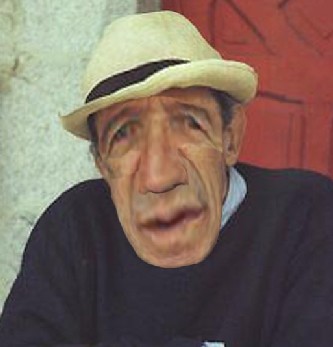
The picture is for visual interest only - it is NOT a distortature of the idiot concerned.

Tuesday, November 25, 2008

Podcast: Hunting Humbug 101 - Tutorial 08: Gibberish


In this pod we discuss esoteric and discombobulating language - Gibberish.


Here's the link to direct download: (34 mins & 16 mb) and you subscribe here: http://huntinghumbug101.podbean.com/feed/or by clicking one of the buttons below.

One example we use is from Yes Prime Minister - The Smoke Screen.

The other examples are from Richard Dawkins' Tanner Lectures. (The gibberish comes in the form of questions asked to Richard Dawkins - he was lucid as ever.)
  • Richard Dawkins - The Religion of Science - Part 2 - at about 31 minutes into the audio if you want to hear the original.
  • Richard Dawkins - The Science of Religion - Part 2 - at about 11 minutes.
Website:
Share on Facebook
Podcast:
Subscribe with iTunesAdd to my GoogleAdd to my Yahoo

Monday, September 15, 2008

SMOG - simplified measure of gobbledygook

A colleague sent me this link: http://www.harrymclaughlin.com/SMOG.htm. It measures the reading level required to understand text based on the number of syllables per word. It's a great rule/tool of thumb for avoiding Gibberish.

The SMOG calculator doesn't automatically tell you if something is gibberish, in that it is reasonable to use complex language in order to increase the precision of what you mean. That's the trade off a writer (who wants to be understood) must balance - precision vs complexity. Writers of gibberish deliberately minimise precision by increasing complexity. The hope is we won't understand they have nothing to say; moreover, given the complexity we'll think we just aren't clever enough to understand what they are saying. Clear writers, on the other hand, only increase complexity when there is a marked and necessary increase in precision.

For example, consider this from an older post on gibberish:
The criticism of our time... is indissociable from an investigation and experience of its transcendental field(s), of the (impersonal) tendencies and haecceities which traverse it, as well as the potentialities, utopian ones perhaps, with which our present can be composed. This 'geological' aspect of 'total critique' is of course essential to a dislocation of the present as atrophy and stultifying repetition of doxa.
SMOG grade of 18.97 = post graduate degree required.

"The 'geological' aspect of 'total critique'...". lol. Compare this to the wikipedia entry on Quantum Electro Dynamics. Even though you might not understand the terms used, it's still clear the paragraph actually means something. The complexity is due to the necessary use of precise technical terms - quantum mechanics is bloody technical and complex:
Physically, QED describes charged particles (and their antiparticles) interacting with each other by the exchange of photons. The magnitude of these interactions can be computed using perturbation theory; these rather complex formulas have a remarkable pictorial representation as Feynman diagrams. QED was the theory to which Feynman diagrams were first applied. These diagrams were invented on the basis of Lagrangian mechanics. Using a Feynman diagram, one decides every possible path between the start and end points. Each path is assigned a complex-valued probability amplitude, and the actual amplitude we observe is the sum of all amplitudes over all possible paths. The paths with stationary phase contribute most (due to lack of destructive interference with some neighboring counter-phase paths) — this results in the stationary classical path between the two points.
SMOG grade 15.07 = some college.

A bunch of wikipedia writers can explain some of the most complex physics going using less esoteric terminology than an archetypal continental w@nker philosopher. Maybe french philosophy is lost in translation: "...a dislocation of the present as atrophy and stultifying repetition of doxa." or maybe not? 'Nuf said.

Saturday, August 23, 2008

The SHAM fallacies

A few posts ago I mentioned a book by Steve Salerno, SHAM: Self Help and Actualization Movement - How the gurus of the self-help movement make us helpless. I've just moved into a new job, and as a token of appreciation from the employer I was leaving I was given a book voucher. (I was told they gave me a voucher rather than choosing a book for me, as they know I've read almost everything and I have very particular tastes... not that they knew nothing about me and could not be bothered to think about it, as I had originally assumed.) I decided to hunt down SHAM, and was successful.

I've just finished the introduction and already it is apparent that Salerno has a great understanding of fallacies. For example, Salerno points out the typically circular - Begging the Question - type of points made by SHAM authors:
This is not to say that all SHAM rhetoric is patiently false. In fact, there are whole categories of self-help precepts that can't possibly be disputed. That's because they're circular - the guru who espouses them is saying the same thing in different ways at the beginning and end of sentence. The conclusion merely restates the premise. Here's a perfect example from Phil McGraw's New York Times number one best seller Self Matters: "I started this process by getting you to look at your past life, because I believe that the best predictor of future behavior is past behavior. That being true, the links in the chain of your history predict your future." The "that being true" makes it sound as if McGraw is rousing to some profound conclusion. But he isn't. The part after "that being true" merely repeats what he said in the first sentence, with slightly altered wording. It's not a conclusion at all. It's what logicians call a tautology.

(Dr. Phil's facial expression, when asked whether he has any data that demonstrates the efficacy of his work, speaks for itself.)

The other technique SHAM authors are fond of is Gibberish:
Other SHAM kingpins, or ambitious pretenders, achieve a certain contrived plausibility by using puffed-up, esoteric-sounding jargon. In August 2004, Dan Neuharth, PhD, the author of Secrets You Keep from Yourself: How to Stop Sabotaging Your Happiness, told the readers of magazine First for Women that "avoidance is a knee-jerk response to a core fear that threatens your ego." Translation: We avoid things we're really afraid of.
It's one of those books that has me nodding in agreement every page. The question I put to people I know with these self-help books in their house is: "How come you have more than one?"

Sunday, June 10, 2007

In Praise of Bad Writing

Full article here: (via Maggie's Farm)

There are at least two benefits of bad writing:

1. It gives an air of profundity. This is a trick Brown learned from many French philosophers (Althusser and Foucault being by no means the worst offenders), English sociologists and (yes) economists. If you write long indecipherable sentences, people will think you're profound and clever rather than muddled and incoherent. If you write clearly, you risk people seeing clearly that you're a fool. In the City, there's a small army of investment writers who are paid to make the inane twitterings of fund managers seem important. They don't do so by pursuing clarity.

2. It allows readers to see what they want. Clear writing gives us something to disagree with. Ambiguity doesn't. People wanting to avoid controversy - politicians wanting to keep a united party, "distinguished people" wishing to avoid looking foolish - will therefore write badly. In my case, it's mere stupidity that causes me to write badly. I'm not sure this is true for everyone else.

Sunday, June 03, 2007

Fine article on weasel words and gibberish

With thanks to Barry Williams, skeptic extraordinaire, who drew my attention to this article by John Leo (excerpt below).

In plain English, what does it mean when students “achieve a deficiency” or reach a “suboptimal outcome?” It means they failed. A suboptimal outcome is even worse at a hospital. It means the patient died. The airline industry sometimes speaks of a hull loss. What they mean is that one of their planes just crashed. Here’s more twisted language. Your doorman is now known as an “access controller”, and a receptionist is a “director of first impressions.” Hospital bills can be filled with such language, How about a “thermal therapy unit” (an ice bag) or a “disposable mucus recovery unit”, also known as a box of Kleenex.

Tuesday, May 29, 2007

Future warfighting - confuse the enemy…

with Gibberish. This from page 13 of the ADF’s Joint Operations for the 21st Century:

In Future Warfighting Concept 2003 the ADF adopted Multidimensional Manoeuvre (MDM) as its approach to future warfare. MDM seeks to negate the adversary’s strategy through the intelligent and creative application of an effects-based approach against an adversary’s critical vulnerabilities. It uses an indirect approach to defeat the adversary’s will to oppose us. MDM becomes reality through the application of tailored strategic responses to achieve the desired effects. A fundamental of MDM is the ability to employ NCW and operate in joint task force, interagency and/or coalition arrangements to conduct effective operations.

Current defence operating guidance draws on a strategic framework that has two components: pervasive and ongoing activities, and focused strategic response options. The objectives these responses seek to achieve are accomplished by designing operations to focus on specific and achievable effects, and integrating joint warfighting functions (force application, force deployment, force protection, force generation and sustainment, command and control and knowledge dominance). Effects will occur sequentially and/or simultaneously based on the conditions and the desired end state that the military strategy articulates for any response option.

Can’t we just get bigger guns?

_____________
Hat tip – Ben.

Tuesday, February 28, 2006

Faculty Follies - Those who can't, engage in cant

Colloquy, an online journal put out under the aegis of the Faculty of Arts at Monash University is always worth a visit for those interested in collecting excellent samples of obscurantist academic cant. The following extract from the editorial of Volume 10 (2005) is typical. (The editorial was written by no less than four persons - Rhonda Khatab, Carlo Salzani, Sabina Sestigiani and Dimitris Vardoulakis.)

"Rather, obscurity is that area in thinking which will always remain outside a secure system but in such a way as to make possible - and impossible - the unravelling of thinking. This obscurest shadow of the obscure installs, like the comma, a moment of hesitation and indecision which is not only inevitable but also guarantees the future of thinking and writing. It is then an obscurity that follows Blanchot no less than an obscurity that Blanchot himself follows."
One can only imagine the intense collective intellectual labors which led to this gem of a paragraph. And it only took four authors! What are they saying? I don't know. Whose fault is it that I don't know what they are saying? It is their fault. They wrote it, and their style indicates indifference to the reader, and incompetence with the basic elements of expository prose (syntax, punctuation, word-usage and semantics).

I suspect that if you interrogated each of the authors separately and asked each one to paraphrase the passage, that they themselves would give four different interpretations. Only dills attempt to hide their ignorance and lack of insight behind a mask of "insightful" and pretentious prose. (See Gibberish).

Sunday, January 01, 2006

Discombobulated by Deleuze, I was left dazed and confused

The following serves to shed some light on my aversion towards continental philosophy and cultural studies in general. (If this doesn't serve sufficiently - click on the "Social Text Hoax" link to delve deeper into my psyche.) This Gibberish is a completely fictitious* conversation I "had" with Dr. Alberto Toscano and blogger (soon to be Dr. too) Glen Fuller on Deleuzian method (named after Gilles Deleuze - pictured).

(*Made by cutting and pasting text from Glen's blog as well as inserting my own comments - this conversation never happened - one would have to be bereft of any level cognition to treat this "conversation" with any seriousness - irony very much intended.)
Alberto: The criticism of our time... is indissociable from an investigation and experience of its transcendental field(s), of the (impersonal) tendencies and haecceities which traverse it, as well as the potentialities, utopian ones perhaps, with which our present can be composed. This 'geological' aspect of 'total critique' is of course essential to a dislocation of the present as atrophy and stultifying repetition of doxa.

Theo: I yoused too fink me new lots bout filosofy but wen ewe youse real big words talking bout dis ava french bloke [Deleuze] wat youse real big words, me no me not no much.

Glen: (To Theo) Don't be too hard on yourself. (To Alberto) I imagine 'enthusiasm' as an impersonal (or 'pre-individual', but dividuating) tendency. Bourdieu's work is invaluable for constructing the trancendental fields within which enthusiasm is suspended. A haecceity is the singular 'thisness' of a block of space-time, the 'coming' part of a becoming, which can be defined as event.

Theo: Dang! Wat big wordige ewe youse to. Youse be real cleva.

Alberto: Give it a go Theo. Just grab a Thesaurus and let it rip.

Theo: I doubt I have the time; the flaming golden orb-sphere of the sky is a mere quarter arc-minute from fulfilling its destiny, as prophesised by the BOM, viz moving in the perpendicular (negative), nay, the "vertical" (through the aether), ebbing, fading, eventually vanishing behind the distant horizon. (Though, through one's remembrance of elementary planetary cogitations, one realises the illusory nature of this "event"; it is perceived this way, through mere mortal eyes [stranded, ineffectually, upon terra] due to the effectuation of the ''Geo" rotating about its axis.) Sincerest apologies if I have been somewhat prolix and circumlocutory in the articulation of my rationale behind the crux of my temporal conundrum, apropos to synonym identification for one's oral phraseology. But without careful and well-considered ratiocination one is liable to be misinterpreted - especially in light of recent breakthroughs in pre/post-modern, Über neo, semi-feminist, textual analysis.

Hey! Wait a minute... I did it! I am so smart. S. M. R. T. Oops. I mean S. M. A. R. T. (Apologies to The Simpsons for that last bit.)

Sunday, April 03, 2005

Gibberish from Academe (where else?)

A web address worth visiting for a plenitude – or even a surfeit of Gibberish is Australia's Wackiest Academic Web Sites. The following extract is from a Paper by Dave Eden (ANU) in the e-journal Colloquy. His article is titled Dissonance and Mutations – Theorising Counter Culture.

I think he's saying that he doesn't like computers and TV and other high-tech stuff... sometimes... for other people... like the unwashed masses... but he can handle it OK... because he's like... smart and savvy. I think that's what he's trying to say, but I'm not really sure – I don't think I'm savvy enough.

"This social factory is constituted through the globe on all social territory, and networked together through a dense mesh of digital information systems. The advent of the social factory and the rise of cybernetic communications (the internet, digital TV and so on) are impossible without each other. The social factory thus manipulates and manages multiple sites through computerised communication and the immaterial labour of symbolic manipulation is becoming the most important work of the global industry. More and more emphasis is placed on the creation of consumer desire; on the production of statistical information about all parts of the labour process; on the re-labelling and design of all social territory; on the projection of reified consumer icons (logos) across all interaction; on the meshing of financial markets together; on the co-ordination of planetary weapons systems; the organisation of just-in-time production; international trade."

Saturday, January 15, 2005

Examples of Gibberish

The advocate presents an argument or assertion that is so garbled in its presentation that it is essentially meaningless.

For a comprehensive and considered written commentary on Gibberish (and other fallacies) - see The skeptic's field guide to spotting fallacies in thinking - Humbug!

Podcast: Hunting Humbug 101 - Tutorial 08: Gibberish


Here's the link to direct download: (34 mins & 16 mb) and you subscribe here: http://huntinghumbug101.podbean.com/feed/or by clicking one of the buttons below.

Website:
Share on Facebook
Podcast:
Subscribe with iTunesAdd to my GoogleAdd to my Yahoo