Showing posts with label Burden of Proof. Show all posts

Thursday, January 19, 2023

Can ChatGPT be used for teaching critical thinking and informal logical fallacies?

It's been a while since I last wrote a blog post, but with all the recent media attention (and my own interest), I thought it would be interesting to share some of my results in using ChatGPT. Specifically, using it to replicate the things that this blog, a book and podcast did regularly, back when blogs were big and podcasts were small.


What is ChatGPT and how could it assist in teaching critical thinking and analysing arguments?

Unless you've been a participant in the series 'Alone' since December last year, you've probably heard about ChatGPT, the cutting-edge language model developed by OpenAI that utilises deep learning techniques to generate human-like text. The recently media attention has highlighted its potential to revolutionise various industries and applications, including education. While there are plenty of potential challenges of AI in education, an interesting application of this technology is its potential to help teach critical thinking, informal logical fallacies, and how to analysise/improve arguments.

ChatGPT can be used to generate realistic examples of common logical fallacies and explain where the argument goes wrong. This can help students develop the skills necessary to recognize and avoid these fallacies in their own arguments and in the arguments of others. For example, it can generate a statement like "Vaccines cause autism" which is (sadly) a common logical fallacy called False Cause

Additionally, ChatGPT can be used to analyse and evaluate arguments by generating counterarguments and identifying any weak points in the reasoning. For example, it can be used to evaluate an argument in favor of increasing the minimum wage, by generating counterarguments such as "increase in minimum wage would lead to inflation" or "small businesses would suffer" and help students identify any weak points in the reasoning.

You can also use ChatGPT to facilitate discussions and debates by generating thought-provoking questions and prompts. For example, it can generate a question like "Should the government regulate social media to combat misinformation?" this can help students to consider different perspectives and to develop their own critical thinking skills.

Overall, ChatGPT has the potential to be a valuable tool for teaching critical thinking, informal logical fallacies and to analyse people's arguments. Despite concerns about the potential challenges of AI in education, the technology holds a lot of potential in various fields. As the technology continues to improve, it will likely become an even more powerful tool for educators and students alike.

Hopefully anyone who has played around with ChatGPT has reaslised by now that most the above is a copy and paste from ChatGPT. It's too well written to be me (and it's kind of boring and lacks my use of irony or references to TV shows). 

See below for my initial few prompts and its response.
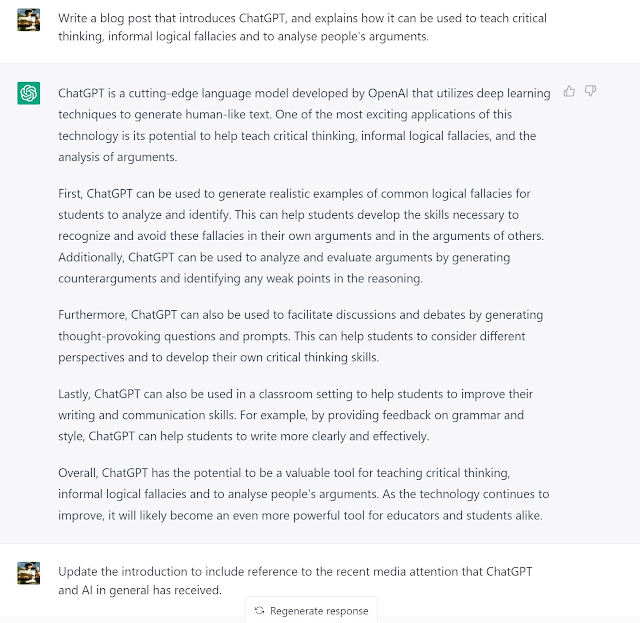

Using ChatGPT to generate an explanation for concept, such as an informal logical fallacy.

My next step was to get it to explain a fallacy.


As Larry David would say, pretty, pretty, good. 


Using ChatGPT to analyse an argument.

I then decided to see how it would go assisting me in analysing text for fallacies, which is pretty much the entirety of this blog. So I tested ChatGPT against some text from this post: No conflict here, just scientists doing their jobs - you know - science


Okay, I told it to look for a particular fallacy. So how about just looking for them in general?

And then again for another bit of text from the blog post:

It's certainly not perfect, and I've found other examples when ChatGPT is completely wrong, but as an assistant and teaching tool it already has a lot of potential. Just as with Wikipedia for doing research, a good starting point for a topic or constructing (or destructing) an argument, but not an endpoint.  
We said in the introduction to Humbug!, that the book: 
...is more a tool to consult as the occasion demands, rather than a book to read in a linear fashion. You may find it to be a useful resource for those occasions when you read or hear a suspect statement or claim, and want to identify the flawed reasoning in the assertion.
If I ever do a 3rd Edition I'd probably update this point to suggest running the suspect statement or claim through ChatGPT or an equivalent AI, and then checking its output against an authoritative source. Speaking of which (and as an aside) I just realised that according to Betteridge's law and my headline, all of the above is wrong.

Friday, January 18, 2013

Burden of Proof

Other Terms and/or Related Concepts

Onus of proof; appeal to ignorance; (c.f. burden of solution).


Description

The burden of proof fallacy is a common rhetorical trick employed in debating and other public forums. It takes place when the advocate claims that the opponent needs to disprove the advocate's case and if he or she cannot, then (by default) the advocate's case is made. The situation is deliberately distorted to tip the balance in favour of the advocate. The key to identifying where the burden of proof actually lies is that it belongs to the person asserting a claim. An advocate making a claim who shirks the burden of proof is guilty of the burden of proof fallacy.

Example

Peter Fantickler is studying biology at university. His lecturer has just outlined the curriculum for the semester. It includes evolution. Peter raises his hand and asks:
Why isn't Intelligent Design on the curriculum? You are going to teach us that all life evolved from one thing to another. But there are forms of life and components of living things that are too complex to have evolved, which biologists can't explain. It must mean they were designed by an intelligence.

Comment

Intelligent Design (ID) claims that in the living world there are irreducibly complex objects that cannot be explained by evolution by natural (and sexual) selection. Given this, they argue, and given these structures are complex and clearly have a purpose, they must have been designed by an intelligence. The CliffsNotes version - you cannot explain this phenomena, therefore my explanation wins (even if mine doesn't actually explain it either).

This is certainly not how one argues for a scientific hypothesis. For a theory to be considered plausible there needs to be evidence for it. It doesn't simply "win" if another theory is missing the occasional explanation (though all the things ID proponents claim evolution can't explain have been explained by evolutionary biologists in an orthodox fashion).

If for the sake of argument we grant ID proponents their first premise, that there are "irreducibly complex" living systems, we do not need to grant them their second. If there is an irreducibly complex living system whose evolutionary history cannot be explained, it does not automatically follow that it was intelligently designed. All that can be said is: "We don't know." In the example above, Peter is being fallacious when he appeals to the (supposed) ignorance of biologists as positive evidence for Intelligent Design.

The burden of proof falls on proponents of ID to make their case. They, of course, do not propose how these structures were designed, put together and built. Their explanation is not an explanation. It explains precisely nothing.

Two more examples:
  • "You can't prove god exists, therefore he doesn't."
  • "You can't prove god doesn't exist, therefore he does."
The above invoke the appeal to ignorance. In both cases the lack of proof for the initial claim is taken as evidence for the contrary claim and as such are fallacious. When any proposition (e.g. aliens visit the Earth to observe us; indigenous people are more spiritual; problems in this life are due to events in past lives; dreams are a form of astral travel) can't be disproved, it doesn't mean that the proposition is therefore proved. A claim needs to provide positive evidence of its own. A lack of evidence for a contradictory claim helps, but it is not positive evidence.

It is perfectly appropriate for each of two parties to a dispute to ask for compelling evidence from the other person to support his or her case. This is skepticism in action. The problem only arises when the advocate takes the position that his or her own case is necessarily made if the opponent's case cannot be made.

Sunday, January 13, 2013

Burden of Solution

Other Terms and/or Related Concepts

"That's your/their problem... not my problem" (c.f. burden of proof); perfect solution.


Description

The advocate denigrates a particular action an organisation, a government, or an opponent wishes to take to address an acknowledged problem. At the same time, the advocate doesn't attempt to provide any alternative solution. He or she tends to characterize any deficiencies or limitations in the opponent's proposed solution as morally reprehensible or fatally flawed.

Example

It is morning tea in the Faculty of Applied Sociology at the University of Wooloomooloo. Dr Roni Tunnell, a lecturer in holistic cultural autoeroticism is railing against a request from the Faculty Board. The board has asked him to "show cause" why his elective on Gendered Psychic Self-Pleasuring should not be cancelled. The board has pointed out that his average enrolment of three students over the last six semesters is not really viable in times of financial stringency. "It's not my job to justify my course, or to find ways of increasing enrolments, or to find external sources of funding, that's their job... that's what those stupid lazy bastards are paid for."

Comment

While we can understand the vehemence of Roni's response to a possible threat to his sinecure, he is not doing himself any favours with his intransigence. The board has put forward the obvious solution to this type of financial crisis – cancel non-viable electives to increase efficiencies in staffing. Roni is refusing even "part-ownership" of the problem. He is rejecting the board's solution. At the same time he is refusing to provide any viable suggestions of his own. He is avoiding the burden of solution by attempting to place the responsibility for finding a solution on the board. Further, any solution coming from the board must meet with his approval.

The burden of solution fallacy is commonly encountered in contributions to public debate on sensitive and difficult issues. Individuals who are fond of displaying ethical sensibilities in public forums are sometimes so self-indulgent that they condemn possible solutions of others and yet offer none of their own. They perceive mere opposition as a "principled stance". They presume to tell others what not to do; but offer no solutions of their own, or they offer "solutions" which are mere wishful thinking.

If (for example) an advocate doesn't agree with economic sanctions to enforce compliance with human rights in a dictatorship, then he or she should offer a better alternative and argue its merits. If he or she is unable or unwilling to do so, then the case must be made that "leaving things as they are" is better than attempting the economic sanctions solution.

If the advocate does attempt to make the claim that the status quo is better than the proposed intervention, the skeptical opponent should be alert to the possibility of wishful thinking (see argument to consequences). The advocate may claim for example that "left to themselves" dictatorships will evolve into pluralist democracies without the application of significant external pressures or interventions – that terror and oppression will eventually fade away in the police state if the leaders of liberal democratic nations engage with, and sweet-talk the dictator. This argument is easily countered by opponents. They can simply ask for examples of dictatorships which have become liberal democracies over a reasonable time-frame without the application of external pressures.

In burdening the opponent with the solution, self-indulgent advocates are mere naysayers, and their opinions have little merit. Further discussion is likely to be fruitless.

It is important to note that one can legitimately criticise a proposed solution without offering one in response. It is not unreasonable for a seeker after truth to admit that they do not themselves have a solution for the problem. In doing so one is avoids engaging in pretense or making light of the complexity of the issue. The burden of solution fallacy requires the sanctimonious criticism of the actions of others, along with an express statement (or an implication) that the critic knows what the solution is.

Monday, February 23, 2009

Podcast: Hunting Humbug 101 - Tutorial 20: Burden of Proof

The Burden of Proof fallacy is the entire "argument" employed in the advocacy of intelligent design - which is the first example we look at. I interview Sandra Quincey about her win in the retraction of the "Sex Magnet". How did she do this? By correctly employing the burden of proof. We also start a semi-new segment "spot that fallacy", based on the non sequiturist Jeni Barnett.

icon for podbean or listen


The clip on Intelligent Design and Irreducible Complexity is from Unlocking the Mystery of Life.

Sandra Quincey had a win over Century Mail and their "Sex Magnet".


And here's the retraction they had to make.


Sandra did this through the Therapeutic Products Advertising Complaints Resolution Panel. Aussies aren't normally whingers, but this is certainly a noble exception! Here's Harriet Hall, the Skep Doc, on it.

Here's a link to a post on Bad Science that gives you links to the whole Jeni Barnett fiasco, our endless supply of humbug for "spot the fallacy".

Sunday, July 06, 2008

Nude kiddie art critics miss the point

A new furore has erupted over art that uses nude children as the subject. It all began when police confiscated the kiddie porn art produced by Bill Henson. Protesting in favour of freedom of expression, magazine Art Monthly Australia has published a cover of a nude six year old girl (and other nudes kids inside, with supporting articles). The focus of the "debate" is child porn vs art/freedom of expression, as can be seen in this article and most of the comments. For example:
What is this magazine trying to prove? Showing young children naked is 'art'? I would like them to explain the artistic attributes this is displaying. People are being charged having these kinds of pictures on their computers, yet with the word art put next to it its [sic] completely fine. Why does a child need to be naked in the first place? This artist is just trying to get some attention because of the recent media coverage of Bill Henson. If these kinds of photos are being published on [sic] this magazine i [sic] don't want tax payers [sic] money promoting kiddie porn. Posted by: Matthew of Oak Flats 3:55am today
If the issue were this simple I'd be on the side of the artists. First of all, despite my strike through above, the images are obviously not sexual. It's hard to see how it is pornography ("sexually explicit ...material whose primary purpose is to cause sexual arousal") unless all nude images are now considered pornography. Moreover, freedom of expression is one of the cornerstones of democracy, even if the particular expression is crap. As Voltaire is said to have said:
I disapprove of what you say, but I will defend to the death your right to say it.
And from the same website I will ironically quote Noam Chomsky:
If we don't believe in freedom of expression for people we despise, we don't believe in it at all.
One of the few occasion I agree with Noam. I agree with freedom of expression for people I despise. As such, I'm bound to believe in Noam's right to freedom of expression, as I am for all artists. (I don't despise all artists of course... this guy's okay.)

But what about using minors, who don't necessarily know what is best for them, as nude models? This question doesn't even enter the thoughts of the editor of Art Monthly. Do artists have ethics committees that look at the value of what is being done vs the potential harm to the subject? You need such approval to do science on children - something that usually has a tangible benefit. Is a six year old able to give informed consent for such work? No. Her parents do on her behalf. And again, with science, before it gets to the stage parents can consent on a child's behalf, the protocols of the study have been scrutinised by an ethics committee.

It seems parents can inflict nude modelling on their children without such forethought. No doubt the parent of the nude six year old girl would say, "I didn't coerce her, she wanted to do it". Given mum was the artist, it's not going to be obvious direct coercion. It would be subtle and unconscious, but coercion nonetheless.

For the sake of argument, I'll assume the girl really did want to do it. Let's say she wandered into the studio one day and said, "Mummy, I want you to paint me in the nude". So what? It still doesn't make it right. Here's the thing about a six year old girl, she doesn't always know what's best for herself. Hence compulsory education, hence the struggle getting her to eat all her vegetables, hence the battle to get her to brush her teeth... you get the point.

Adults, especially parents, need to make decisions in the best interests of children. This is easier said than done. This rule of thumb can be applied to help. Is undertaking the activity under consideration of obvious benefit? For example, is it reasonable to immunise children? Yes. There is overwhelming evidence it works and as such adults in possession of all the facts advocate immunisation. Is it okay to convince your six year old, nude modelling is okay? No. There is no tangible evidence nude modelling is beneficial (I admit this is an assumption), besides making a career out of it (but I don't think it's reasonable to lock a six year old into any career).

Another rule of thumb is, would a reasonable person in possession of all the facts (observable, evidence based consequences) undertake the activity under consideration? Again, is it reasonable to immunise children? Yes. Adults in possession of all the facts tend to advocate immunisation. Is it okay to convince your six year old nude modelling if okay? No. Most adults in possession of the facts do not nude model.

I'm happy for adults to not get themselves immunised. They can model in the nude if they wish. What I'm not happy about is adults assuming the default position is they can inflict their own beliefs on children, do whatever they want with their children, unless someone can show it's bad. The default should be to stick with social norms unless you can show the social norms are bad, or what you want to do (that goes against the social norms) is of benefit. I.e., the Burden of Proof is on those breaking away from the social norms. If you are right, this should be a relatively easy argument to win (that doesn't mean it's easy to change people's minds however). The change in the use of male pronouns in the English language is a case in point.

I'll end this post with this rhetorical question: cui bono? It's clearly not the six year old girl. It's her mother who initially took advantage of her in the name of her art. It's Art Monthly Australia's editor, who has continued to take advantage of the girl under a misguided defence of freedom of expression. Freedom of expression is not the same a freedom to take advantage of children.

Sunday, January 08, 2006

9-11 Conspiracy theorist - Part 2

I've already posted on 911 in Plane Site, but it's pure gold for a "fallacy finder" such as myself. In response to a review of the show by Gordon Farrer of The Age, the conspiracy theorist and delusional paranoid (note my continued Personal Abuse) Dave "The Dirty One" von Kleist, motivated, only by an insatiable need to become a famous country singer (note that I am Impugning his Motives) serves up a few more:
On our radio program, we have interviewed a two-star General, an Air Force Colonel (with 30 yrs. identifying aircraft ant aircraft parts), an Army Major, Air Force Major, a 33 yr. veteran of the DoD in missile defense systems, numerous Airline pilots including an instructor, and the United Airlines pilot who flew Flight 175 up to two months before 9/11 when he retired. They agree that a 757 could not have caused the damage at the Pentagon and that the planes that hit the towers could not have been commercial aircraft. That is their opinion not mine.
Now, how many of these "experts" have seen a 757 fly into a building before or after 9-11? None I'll wager. Yet somehow, by merely looking at photos, they can tell that it's impossible that a plane caused the damage? "Attributing Authority" to these people is fallacious for two reasons. False Attribution - as the sources The Dirty One cites aren't "experts" in the correct field, they are made up of people who are irrelevant (at best marginally relevant), unqualified, and unidentified (and for all we know - non-existent). (The correct "experts" I assume, would be from the fields of engineering, ballistics and demolition.) And two, Appeal to Authority - Dave does not explain why they hold this view, but merely presupposes their "eminence" will suffice as an argument.

The Dirty One continues:
What "experts" can you bring forth to support or justify your condemnation of the hard photographic evidence presented in the film? I would be most interested as to what your explanation would be in regard to the "pod" and the "flash" is. How do you explain the Pentagon photos and footage taken before the collapse of the "E" ring? I noticed (and so did many of your readers) that you didn't address any of these issues. In fact, you didn't address one issue, not one. I would challenge you to do so however, coward "journalists" usually throw their rocks, shoot their arrows and then run and hide. Prove me wrong.
Ah, the Burden of Proof fallacy. One of my "favs". Dave has no actual evidence for his case (like footage of a missile or eyewitness accounts), he merely makes spurious claims with selective use of videos and photos. So instead of making his own case with actual evidence, he says: "If you can't prove me wrong, then I must be right." Well, lots of people have "proved you wrong".

The above link serves to demonstrate The Dirty One's Deck Stacking. All his claims are bogus. One example of a bogus claim is when Dave argues: "If it was a plane that hit the Pentagon, where's the wreckage?" To which he shows photos where wreckage can't be seen (and implies he has looked at all the photos there are). Well, here's one Dave! Oh, I see, you have seen it. Of course! The wreckage was planted… and the photo only came about months later? Question! Why would "they" wait to release a photo of "planted" evidence Dave?

I know a little physics, and I vaguely recall some terms - work and energy. Reminded of this I thought to myself, in order for a plane travelling at a high velocity (large Kinetic Energy) to come to a halt, something would have to do work on it (apply a force over a distance). If the force was relatively small (like the resistance from brakes and air), the distance would be quite large (say, at least the distance of a runway). With a bigger force (perhaps resistance from a building), the distance would be smaller (say, the distance to travel completely inside the aforementioned building). Given the plane travels inside the building, it's hardly a surprise that the wreckage of the plane is also in the building (for where else could it be?) which then, due to loss of structural integrity, collapses on top of the wreckage.

Dodgy Dave, in his "documentary", also likes to use eyewitness accounts. He only uses a couple to help his cause, but fails to quote the hundreds of other eyewitnesses. Yet more Stacking the Deck.

If you need any more evidence that Dave "The Dirty One" von Kleist is a liar - re-examine the photo of him. It was taken after a questioner asked Dave if he was taking any of these. Dave initially responded "No", but when he realised his "tell" (Pinocchio Syndrome) had given him away, he got all grumpy.

Update: Popular Mechanics - 9/11: Debunking The Myths