
Tuesday, July 04, 2006
Philosophers’ Carnival 32
The latest Philosophers’ Carnival is up at Adventures in Ethics and Science. Go there and read stuff. I have this post there.


Monday, July 03, 2006
The iron fist in the velvet glove metaphor
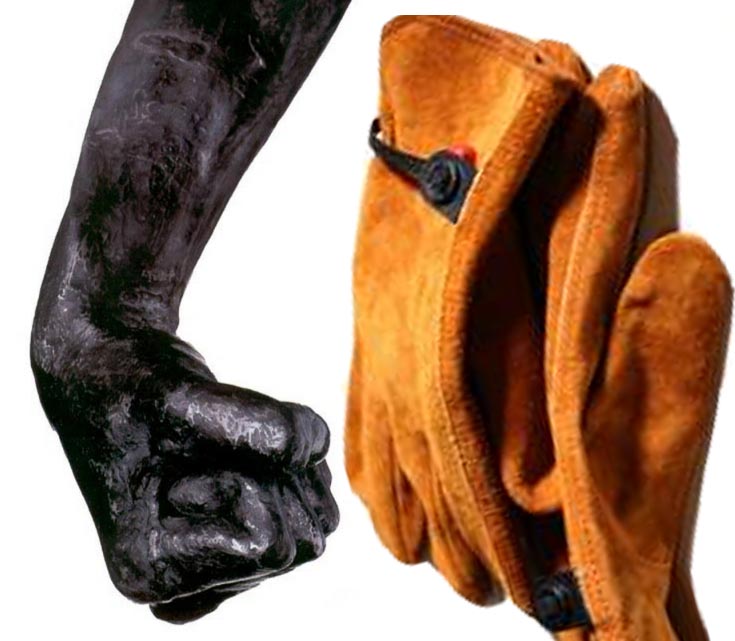 Basic Behaviour Management 101 (not to be quoted in an interview for a teaching job BTW):
A teacher needs to have an iron fist, which they keep in a velvet glove. The students choose whether the glove stays on or comes off. If they want to learn, and demonstrate this through appropriate behaviour, the teacher guides them, with a soft, gentle, velvety hand. If they make the inappropriate choice, the teacher removes the glove and…
Remember, it is only a metaphor, however, I think there's something in it for all of us.
________
Tagged - Education
Sunday, July 02, 2006
Putting the 'M' in stupid
Feel free to use this ad hominem attack next time you are stuck talking to a believer of conspiracies:
Look, all your points are utter crap and I won't even pretend to humour you. From my own experience, those who believe in conspiracies are either completely delusional and out of their minds, or so moronic they put the ‘M’ in stupid (or both); with the one notable exception being renowned intellect Charlie Sheen. You're not Charlie Sheen, so which category do you belong to?
This would obviously need to be modified when talking to Charlie Sheen.
______
Tagged - Fallacy Skepticism, Personal Abuse.
Look, all your points are utter crap and I won't even pretend to humour you. From my own experience, those who believe in conspiracies are either completely delusional and out of their minds, or so moronic they put the ‘M’ in stupid (or both); with the one notable exception being renowned intellect Charlie Sheen. You're not Charlie Sheen, so which category do you belong to?
This would obviously need to be modified when talking to Charlie Sheen.
______
Tagged - Fallacy Skepticism, Personal Abuse.
Saturday, July 01, 2006
Falsification
If someone proposes some theory about something, could it be tested? Karl Popper argued that science proceeds by refuting false hypotheses, not by confirming true ones. Popper's work has been criticised, but what we can say about Popper's idea of falsification, I believe, is that at the very least, for a hypothesis to be worth consideration it needs to be testable by some method. There needs to be some criteria, some kind of evidence (at least in theory), that would allow us to judge the hypothesis false. The more detail it provides – the better the hypothesis. In turn this means that there is potentially more evidence that would warrant judging it false. If we can find no such evidence, then the explanation looks quite strong. Killing erroneous hypotheses is the paradox by which science proceeds. As Popper said:
Our belief in any particular natural law cannot have a safer basis than our unsuccessful critical attempts to refute it.
Falsification should be applied to any idea about how the physical world works. Any hypothesis about the physical world should be falsifiable. The definition for 'hypothesis' I give my students is:
A predictive statement that through experimental investigation could be shown to be false.
Applying falsification to the non-physical world - eg politics and other human affairs - is a little more problematic. However, it's always worth having the idea of falsification in the back of your mind when someone proposes an explanation for something.
When a claim is not falsifiable, you are dealing with an Immunised Hypothesis. Claims about the physical world that are based on immunised hypotheses are pseudo-scientific. Examples of pseudo-sciences that Popper became suspicious of are psychoanalytic beliefs such as those of Freud and political Ideologies such as Marxism. These theories can never go wrong, as they are sufficiently flexible to accommodate any type of new behaviour. No observation or test can show these theories to be false, as their proponents are able to invent "just-so" stories to account for any possible behaviour. These theories give the appearance of being able to explain everything, but in fact they explain nothing, as they can rule out nothing. Of course there are other pseudo-scientific beliefs we can easily include with the previously mentioned ones - intelligent design, astrology, fortune telling, tarot cards…
In this podcast we discuss Falsification and Immunised Hypotheses.
Here's the link to direct download: Tutorial 02 Falsification.mp3 (20 mins & 18mb) and you subscribe here: http://huntinghumbug101.podbean.com/feed/.
____________________
Tagged - Fallacy Skepticism, Science, Philosophy, Falsification, Hypothesis, Theory.
Our belief in any particular natural law cannot have a safer basis than our unsuccessful critical attempts to refute it.
Falsification should be applied to any idea about how the physical world works. Any hypothesis about the physical world should be falsifiable. The definition for 'hypothesis' I give my students is:
A predictive statement that through experimental investigation could be shown to be false.
Applying falsification to the non-physical world - eg politics and other human affairs - is a little more problematic. However, it's always worth having the idea of falsification in the back of your mind when someone proposes an explanation for something.
When a claim is not falsifiable, you are dealing with an Immunised Hypothesis. Claims about the physical world that are based on immunised hypotheses are pseudo-scientific. Examples of pseudo-sciences that Popper became suspicious of are psychoanalytic beliefs such as those of Freud and political Ideologies such as Marxism. These theories can never go wrong, as they are sufficiently flexible to accommodate any type of new behaviour. No observation or test can show these theories to be false, as their proponents are able to invent "just-so" stories to account for any possible behaviour. These theories give the appearance of being able to explain everything, but in fact they explain nothing, as they can rule out nothing. Of course there are other pseudo-scientific beliefs we can easily include with the previously mentioned ones - intelligent design, astrology, fortune telling, tarot cards…
In this podcast we discuss Falsification and Immunised Hypotheses.
Here's the link to direct download: Tutorial 02 Falsification.mp3 (20 mins & 18mb) and you subscribe here: http://huntinghumbug101.podbean.com/feed/.
____________________
Tagged - Fallacy Skepticism, Science, Philosophy, Falsification, Hypothesis, Theory.
Subscribe to:
Posts (Atom)

The Skeptic's Field Guide by Theo Clark and Jef Clark is licensed under a Creative Commons Attribution-NonCommercial-ShareAlike 3.0 Unported License.