Showing posts with label False Dichotomy. Show all posts

Friday, April 25, 2014

The F-35 false dilemma

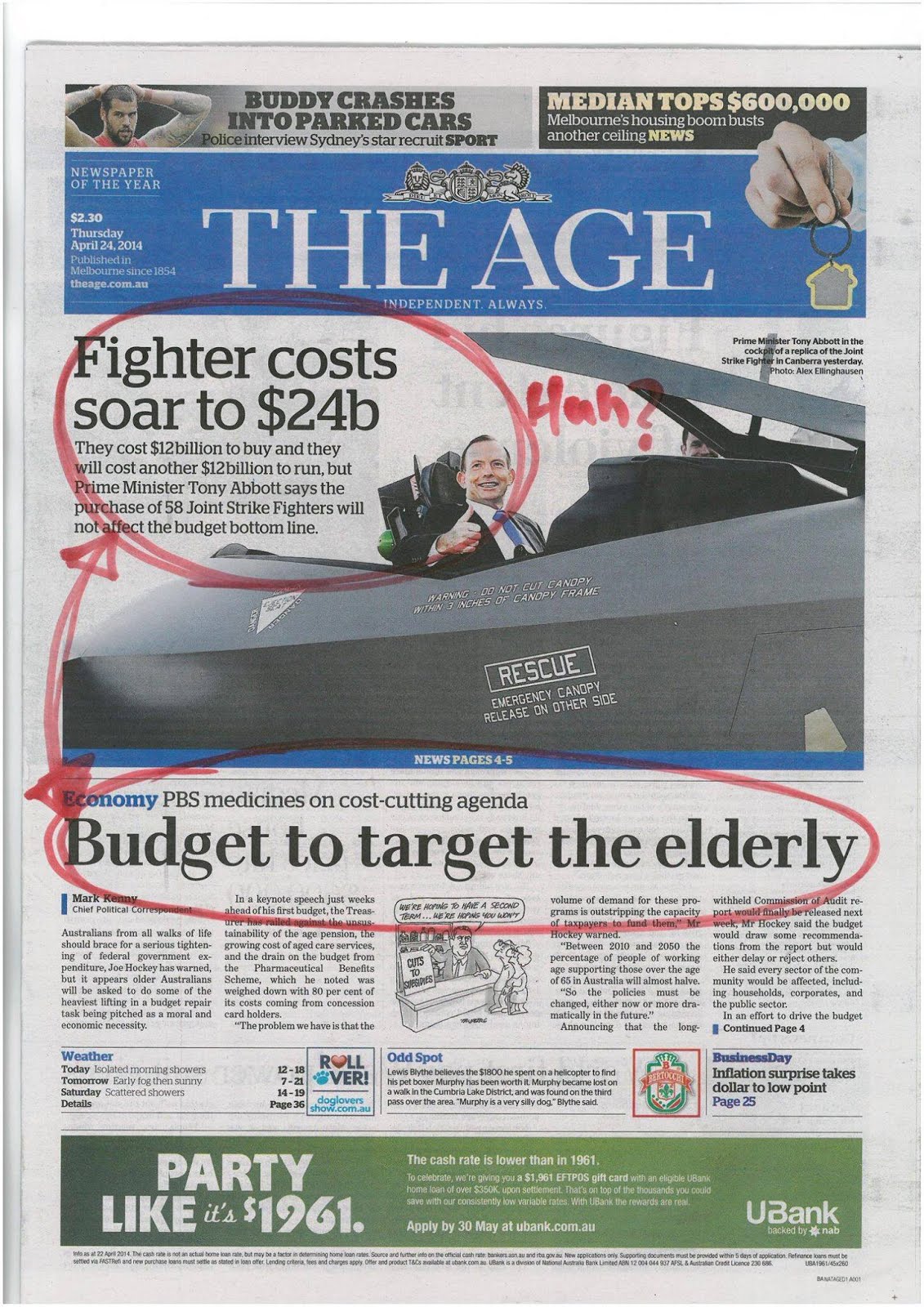
Ever since the announcement that the Australian Federal Government is going to buy 58 more F-35 Joint Strike Fighters at a cost of $12.4 billion, the anti-Government social media memes have been in full swing.

10273087_10151960773321455_663271279668348792_o.jpg
There’s nothing wrong with criticising any specific Government policy. The report linked to above outlines some of the (I assume legitimate) criticism of the JSF program. However, memes such as these are examples of disingenuous (I won’t say idiotic) and win-at-all-costs thinking that only serve to reinforce partisan politics and do not lead to civil discourse or help with getting to the truth of a matter. 
Specifically, these arguments make the false dilemma fallacy - the error of portraying one choice as necessarily excluding another, even though there is no necessary connection; and the false cause fallacy - asserting there is a causal link between the funding of the JSFs and other funding. 

Even if one doesn’t like a particular political party, organisation or person, every issue should be treated on its own merits and in good faith. To do otherwise is to engage in dogmatic unthinking. Politically, announcing the $12 billion spending adjacent to discussion of spending cuts in other areas might not have been very savvy. However, a disinterested analysis recognises that one has nothing to do with the other, anymore than any other government expenditure. 

The total 2013 budget for Australia is almost $400 billion. As this interactive shows, social security and welfare is $138 billion, education is nearly $30 billion, and recreation and culture is $3.7 billion. These figures are for a single year. 

My understanding is the $12 billion had been accounted for in the defense spending cycle. Unless you are a complete pacifist who believes Australia should disband its military (in which case I say good day to you sir/ma’am, could you please leave my website and go back to playing with your imaginary rainbow unicorn), you will recognise the need for this spending. You might disagree with this specific program, on its own merits, but not based on some supposed link to another completely unrelated program. 

Unless you can establish that Australia could spend, say, $3 billion less on alternative fighters that have similar capabilities; and that this $3 billion could go to another area of government expenditure, you are clearly interested in winning a political fight, rather than discussing a real issue.

Wednesday, January 09, 2013

Exaggerated Conflict

Other Terms and/or Related Concepts

Inflated conflict; exaggerated dispute; false dichotomy.


Description

The advocate expresses the view that because there is a dispute between experts in a domain of knowledge, the entire field of scholarship (or at least the specific issue in dispute) should be rejected.

Example

Graham Flatliner is eating with gusto his second bacon and egg burger of the day. His concerned workmate Ed Fuddy is witnessing his consumption. Ed is finally moved to remark: "I don't understand how you can eat so much of that... I feel ill just imagining the way the cholesterol is coating your arteries. If you keep eating like that, your high level of cholesterol means you will get heart disease and keel over before you reach fifty."

Graham responds: "That's not true. I was reading about a doctor in Sweden who is an expert in heart disease. He recently completed a study in which he found no link between dietary cholesterol and heart disease, so high cholesterol won't give me heart problems. The so-called experts are always changing their minds and they can't even agree amongst themselves. Next year the Heart Foundation will probably recommend deep-fried pork crackling."

Comment

Outright rejection of a field of knowledge just because there is some level of dispute in the field is fallacious. After all, any field of inquiry advances through a degree of dispute and debate. At times, professional disagreement even at the margins can lead to rivalry and hostility. When such disagreements become public, non-specialists may be dismissive of the whole field. This is not an appropriate position for the seeker after truth. The critical thinker does not dismiss anything out of hand. He or she examines an issue and makes judgments consistent with the revealed facts.

In the present example, and if Ed were a seeker after truth, he might ask Graham for the details of the Swedish research paper. In the meantime, he could point out to Graham that it is the weight of evidence that matters when individuals are trying to make healthy lifestyle choices. He could explicitly reject Graham's position by pointing out that Graham is exaggerating the degree of uncertainty in research on the role of dietary cholesterol in heart disease. The reasonable person will not regard uncertainty in any field of inquiry as a problem. Uncertainty is far better than dogmatism or unjustified certainty. However, lack of absolute consensus does not mean that "anything goes".

Another fallacy examined in this book, false dichotomy, may at times be difficult to distinguish from exaggerated conflict. The key feature of exaggerated conflict is the tendency of an advocate to dismiss a field of inquiry because of a false claim that "the experts" are in complete disagreement.

If the experts are in complete disagreement, then it is appropriate to reserve judgment about the issue, or to make a provisional decision one way or the other, while remaining open-minded and ready to change a decision as more information emerges. Note that "sitting on the fence" on an issue pending more information is a perfectly respectable position for a seeker after truth to take.

Sunday, November 11, 2012

False Dichotomy

Other Terms and/or Related Concepts

Excluded middle; black-and-white reasoning; false dilemma; polarization of debate; forced choice.


Description

The advocate presents an issue as "black and white" when it is in reality "shades of grey". The reasoning put forward is unjustifiably "all or nothing" rather than subtle and measured. Debates about emotive issues such as euthanasia, GM foods, criminal justice, race relations etc., are often polarised in this way.

Example

During an election campaign, the incumbent Attorney-General, Frances Payne appears on television and makes his case for a review of current censorship laws affecting television broadcasting. She states that the review of the laws will be informed by broad community consultation. The interviewer (Barbra Twining) asks Mitchell Blarneypickle (President of the lobby group Smashing Hegemony In Television) to comment. He states: "There cannot be any censorship imposed by the State... anyone should be able to hear or see anything they like... any level of censorship is oppressive."

Comment

Mitchell is portraying the issue as censorship versus freedom of speech. He is attempting to put one issue up against the other and is hoping that his version of the issue prevails in the "contest". The flawed belief at the core of this strategy is that censorship is "all or nothing". In fact, the degree and nature of censorship which might be exercised in any society is subject to multiple variables. It is perfectly reasonable for example, for standards of what constitutes obscene or violent material to change over time along a continuum. The debate should be about how far along the continuum and in which direction the standards should shift - not on whether standards should be abandoned or raised to a level of complete repression.


In the present example, and if Barbra were an effective interviewer, she would challenge Mitchell on his "all-or-nothing" stance and either dismiss it as an unworthy contribution to the debate, or probe his position with examples which would be problematic. For example, she could ask her whether he would be in favour of live broadcasts of executions on free-to-air television, or the removal of doors and screens from public toilets. Such challenging examples would be an appropriate use of reductio ad absurdum by Barbra to point out that it would be ludicrous to apply Mitchell's views without qualification. Such a challenge might provoke Mitchell and lead to his indignant exit from the debate. But it's also possible that it would function as a reality check and cause him to modify his position and engage more effectively in the discussion. Either way, whether he leaves or moderates his position, the debate would be more fruitful.


Many LAME commentators (LAME - Look At Me Everybody are unhappy with ambiguity and complexity. Such individuals prefer to characterize an issue as "black or white", as they find dealing with nuanced shades of grey difficult and confusing, and more often than not, a threat to their position. The seeker after truth on the other hand, should not attempt to over-simplify any issue in order to bring it to a premature or unjustified resolution. It is much more acceptable in principle to decide that an issue has to remain unresolved, rather than oversimplifying and drawing the wrong conclusion.

Tuesday, May 01, 2012

The Perfect Solution

Other Terms and/or Related Concepts

Silver bullet; burden of solution

Description

The advocate claims that because a proposed solution, idea, or system is not perfect, it should be abandoned completely.

Examples

1. Radio "shock jock" Kyle Jones is angrily discussing the speeding fine he received on the way to work in the morning. "These hidden camera speed traps are complete rubbish. I got caught speeding. Big deal. Down the road, after getting the ticket, I was immediately speeding again. They don't work. People still speed. It's just government revenue raising."

2. Recent changes in the sport of tiddledywinks, allow a referee to use slow motion video, infrared "hot spot" cameras and trajectory tracking and prediction "laser eye" software, in any close decisions. This really upsets commentator Gumptal Flabernarky. Commentating on a review in which he believed the referee incorrectly referred, he states: "Is he kidding himself? Even with the slow-motion replay he got it wrong! I could've told him that without the replay. What a joke this use of technology is. If he can't get it right even with the slow-mo, then why have it at all?"

Comment

In the first example, Jones argues that because the enforcement of speeding laws will not be able to catch every person who speeds (the system is not perfect), we should abandon any enforcement completely. This fails to take into account that it is not intended to be perfect and that enforcement is, presumably, intended to be a deterrent. If such a deterrent leads to less speeding and as such, lowers the road toll, then on balance it's probably a good thing.

The Perfect Solution fallacy is closely related to, and often made up of, the fallacies False Dichotomy and Burden of Solution. Speeding and enforcement of speeding laws is not a black and white issue. We need to consider how we deal with different degrees of speeding and repeat offenders, and examine the effect of permanent speed cameras, mobile speed traps, highway patrols etc. If we agree that speeding is bad, but do not like the current laws and enforcement, then we should probably propose other mechanisms, or risk being guilty of the Burden of Solution. How else can we try to stop motorists from speeding other than fines and court appearances? One cannot denigrate the current system, fairly, without proposing some other solution (or at least acknowledging one's own failings).

It is also worth noting that Jones goes on to impugn the motives of the police and government, stating that speeding fines are really about revenue raising, rather than lowering the road death and injury toll. He also fails to acknowledge that most other people wouldn't keep speeding after getting a fine, because most other people aren't self centered wankers.

In the second example we, the audience, are able to see that a referee made the wrong decision because we can check using technology. Yet Flabernarky goes onto argue, because the technology is not perfect, the referees ought to not use it to help make decisions? A self-contradictory argument if there's ever been one.

By analogy we can see the absurdity of this position. "Even with the very latest high resolution medical imaging equipment doctors still make incorrect diagnoses! What a joke this use of technology is. If doctors can't get it right even with the the latest technology, then why have it at all?"

Tuesday, September 14, 2010

Lady Gaga creates a false dichotomy

Most skeptics familiar with the Huffington Post would be well aware of its poor track record when it comes to logic and critical thinking. This is usually the case in any of the posts they write about science or health. But this time it has crept into something that is normally immune to sloppy thinking - pop culture! (It's immune because pop-culture is devoid of anything requiring critical thinking...)

They asked an important question regarding Lady Gaga's recent appearance at some award show, where she wore a dress made out of raw meat. "Lady Gaga's meat dress - offensive or awesome?" Ugh, what's offensive is the obvious False Dichotomy.

Lady Gaga's meat dress could be offensive but not awesome, awesome but not offensive, or both offensive and awesome (or neither). And this presumes, without any basis, these are the only two options. What about LAME?


I may have voted for awesome...

Saturday, January 03, 2009

Why I like Christopher Hitchens

Name another outspoken atheist and skeptic who would point out the idiocy of the "George Bush is so dumb..." jokes. He has to be the best example of a free thinker there is (more so than most self-proclaimed free thinkers I've met, who all laugh along at idiotic "George Bush is so dumb..." jokes). The fact that people still identify themselves as either right or left wing, what should be an obvious false dichotomy, tends to show they are in fact unthinking drones. Hitchens takes each issue on its own merits and applies the same ruthless logic, no matter where the conclusion takes him. (I might not always agree with his reasoning or conclusions.)

He is also more than happy to give people the finger. Another reason to admire him.


Saturday, December 20, 2008

Podcast: Hunting Humbug 101 - Feedback on False Dichotomy and False Dilema


Here's the link to direct download: (15 mins & 7 mb) and you subscribe here: http://huntinghumbug101.podbean.com/feed/or by clicking one of the buttons below.

A podcast in response to a question on one of the examples we used for a false dichotomy - in Podcast 6.

Here’s the email we are responding to:

___________________

As an American, I got a dose of culture shock at about 2 minutes in, when reading from your book. You give an example of someone saying that the government has no business censoring anything, and that any censorship is oppressive. You seem to claim that the argument should be about how much censorship to have, not whether to scrap it entirely. As someone who basically agrees with your \”Margo Blarneypickle\”, I take issue with this. More censorship is more oppressive, but any amount of censorship is, indeed, oppressive. This is not an unusual view around here: heck, it\’s written into the US constitution that the government isn\’t allowed to censor anything.

You then go on to suggest that \”Margo\” be ridiculed with straw men. \”Are you in favor of live broadcasts of executions?\” Well, I\’m not in favor of executions. But if you\’ve got the film, it shouldn\’t be illegal to show it. I mean, are you going to outlaw everything that\’s in bad taste? \”Do you favor the removal of doors from public toilets?\” WTF? Of course not. That\’s a false analogy. Censorship isn\’t allowing toilets to have doors, it\’s legally requiring every toilet to have a door. If I want to build a doorless toilet, it shouldn\’t be illegal. I probably shouldn\’t expect many people to buy one, or to use one, but censorship is making it /illegal/ to have or use one.

When the worst that could happen is that someone is discomfited or offended, there is no reason to hand a potentially abusable power to a government that can\’t (http://journal.neilgaiman.com/2008/12/why-defend-freedom-of-icky-speech.html) and won\’t (http://www.theage.com.au/news/home/technology/police-defend-baby-swinging-video-charge/2008/12/11/1228584982919.html) confine itself to banning just the bad stuff.

Give to your local free speech organizations. http://www.go.to/aclu http://www.efa.org.au/

P.S. The email in your profile doesn\’t seem to work. P.P.S. I have been enjoying your podcast, excepting this one bit which pushed a button for me. Keep up the good work.

Subscribe with iTunesAdd to my GoogleAdd to my Yahoo

Tuesday, November 11, 2008

Podcast: Hunting Humbug 101 - Tutorial 06: False Dichotomy and False Dilemma


In this podcast we discuss False Dichotomies and False Dilemmas.


Here's the link to direct download: (30 mins & 14 mb) and you subscribe here: http://huntinghumbug101.podbean.com/feed/or by clicking one of the buttons below.

These are the three examples we specifically speak about on the podcast:
Website:
Share on Facebook
Podcast:
Subscribe with iTunesAdd to my GoogleAdd to my Yahoo

Monday, June 30, 2008

Name that Fallacy – Occam’s razor “debunked”

I thought I’d probably start a semi-regular post, ripped off from the The Skeptics' Guide to the Universe podcast, which I’ll name, Name that Fallacy. I say “probably”, and “semi”, as I’ve made such claims before and they’ve fizzed out. (See LAMEASS of the Month for example.) This has more potential than others as it’s lazier. I’ll provide a passage of text and invite readers to identify the fallacy. Preferably you’ll explain why it’s a fallacy and the particular fallacy you think it is.

This first one is from the aptly named Winston Wu (I’m not the first to make that connection I’d wager) , who frames himself as the “skeptic debunker” There is much fallacious material on his website for me to choose from. I thought I’d start with this egregious example on his “debunking” of Occam’s Razor. He makes a few points about the razor, but the particular fallacy I want to concentrate on is in point 1. Bare in mind there is more than likely to be more than one spin on this (bets firmly hedged):

Argument # 3: The Occam’s Razor rule

Stated as: “When there are two competing explanations for an event, the simpler one is more likely.”

This argument is a principle that skeptics often misuse to try to force alternate explanations to paranormal ones, even if those explanations involve false accusations or do not fit the facts. Originally, it began as a principle in physics having to do with parsimony, but somehow got twisted into a mantra for invalidating paranormal claims...

1) First of all, Occam’s Razor, termed by 14th Century logician and friar William of Occam, refers to a concept that states that "Entities should not be multiplied unnecessarily." It was not intended to be used to evaluate claims of the paranormal as skeptics today use it for. As Phil Gibbs points out in “Physics FAQ”: (http://www.weburbia.com/physics/)

“To begin with we used Occam's razor to separate theories which would predict the same result for all experiments. Now we are trying to choose between theories which make different predictions. This is not what Occam intended…

The principle of simplicity works as a heuristic rule-of-thumb but some people quote it as if it is an axiom of physics. It is not. It can work well in philosophy or particle physics, but less often so in cosmology or psychology, where things usually turn out to be more complicated than you ever expected...

The law of parsimony is no substitute for insight, logic and the scientific method. It should never be relied upon to make or defend a conclusion. As arbiters of correctness only logical consistency and empirical evidence are absolute.”

Even Isaac Newton didn’t use Occam’s Razor like the skeptics of today do. His version of it was “We are to admit no more causes of natural things than such as are both true and sufficient to explain their appearances.” (see same Physics FAQ)

Can I suggest, before you have a crack – read my “skeptic” definition of Occam's Razor. You can then browse about the Fallacy List to give you an idea.

If you’re too lazy to click a link, here’s Carl Sagan’s definition from the Demon Haunted World (original emphasis):
Occam's Razor. This convenient rule-of-thumb urges us when faced with two hypotheses that explain the data equally well to choose the simpler.
If you’re already a top gun skeptic, then reading that probably wasted your time, so sorry…

I’ll put up my answer in a week or so.

Ps. Don’t look any comments (assuming I get any…) until you’ve thought about it a bit.

Pps. A fallacy he isn't making is Appeal to Authority (even if he is citing Isaac Newton).

Tuesday, April 03, 2007

Newsflash - Wikipedia isn't perfect!

Jef suggested we add the Perfect Solution fallacy to our list a while ago, but it wasn't until watching TV on Sunday morning that I came across a nice example of it. Sunday (an Australian public affairs TV program) ran a story: Wikipedia — right or wrong? Here's the synopsis:

School students love it, but increasingly their teachers don’t want them to go near it. It's Wikipedia — the massively popular, free Internet research tool. And it's growing like crazy. Since it first appeared five years ago, it's amassed 1.7 million entries in English alone. Its founder is an American called Jimmy Wales. Once a future and options trader, he’d previously run a website which sold erotic material. He operates Wikipedia as a “not for profit” site, along democratic lines. He’s fond of saying, “its the encyclopaedia anyone can edit”, written not by experts-necessarily but ordinary people. Its critics, like the former editor in chief of Encyclopaedia Britannica, say it's like asking questions of a bloke you meet in the pub. He might be a nuclear physicist, or he might be a fruit cake. A series of embarrassing errors on the site in recent weeks-and-years has prompted debate about whether you can trust Wikipedia. Well, Jimmy Wales is coming to Australia later this month. Sunday spoke to him from Tokyo earlier in the week.

Among reporter Ellen Fanning's points was the heavy implication that as Wikipedia often has mistakes, the entire enterprise is flawed, and should therefore be ignored by intelligent people (presumably such as herself). (She didn't directly make this argument herself, she did the old:"Critics say that...". For once I'd like to see someone respond by saying: "What critics? Who said that?")

In the title of the story, we have a False Dichotomy. However, it's the argument within the story that I'll focus on - the Perfect Solution fallacy. The critics of Wikipedia are right, it does contain many errors, some of them glaring. (Conveniently, there was an error in the entry on Ellen Fanning at the time of her interview with Wikipedia founder Jimmy Wales. It said she was the sister of musician Bernard Fanning... I wouldn't know anything about altering a Wikipedia entry to prove a point. Though to give her the benefit of the doubt, the error was added 21st October last year.) That doesn't stop it from being a very useful resource. It just means that one should not use it as a primary resource. This is what I say to my students:

Can you trust Wikipedia for research? Not really - though it's not particularly worse than the Encyclopedia Britannica for getting its facts right - they're both pretty appalling. See this. It is, however, a good starting point for research - in particular external links.


Pretty sensible and obvious advice I would think. (Make sure you click on the "see this" link above and you'll see the errors that creep into even such estimable publications as Britannica.) Wikipedia isn't perfect, and it doesn't claim to be. Attacking Wikipedia was a bit lame of Ellen. Her next story should be called: Reporters desperately trying to create controversy where there isn't one - Right or Wrong?

Saturday, February 11, 2006

Cartoon violence isn't always LOL funny

A commenter, at The Daily Dish, on the Danish cartoons of Mohammed and the subsequent overreaction by some Muslims about the place, provides an example of a False Dichotomy and/or Dilemma (it was a bit of a dilemma as to which label to use):


"I'm honestly starting to suspect that, before this is over, European nations are going to have exactly four choices in dealing with their entire Moslem populations -- for elementary safety's sake:
(1) Capitulate totally to them and become a Moslem continent.
(2) Intern all of them.
(3) Deport all of them
(4) Throw all of them into the sea.
(Actually, I suppose it's a False "Tetrachotomy", though choices 2, 3 and 4 are essentially the same). I suspect this comment intended to be somewhat tongue in cheek. Even so I sincerely hope that the solution does not lie with the choices listed above… (Then again, given the seeming impossibility of reasoning with people like this, this, and this, maybe he's right? As I can't suggest any alternative strategies myself, I'll just have to live with the shame of committing the Burden of Solution fallacy.)

Update: Prof Juan Cole recognises the complexity of the antecedents to the Cartoon violence, uses them to excuse the mobs, yet still can't help himself - it's Bush's fault.

Update II: Of course, there is plenty of hope with Muslims such as Irfan Yusuf. He doesn't feel the need to make excuses.

Friday, January 20, 2006

Left Wing and Right Wing - a False Dichotomy

I have commented elsewhere on the confusions in the political landscape caused by blurring at the edges of the venerable political designations of right wing and left wing. Venerable because the terms were first associated with the seating arrangements in a long-defunct French parliament. See extract below (source, Wikipedia) .

The term comes originally from the legislative seating arrangement during the French Revolution, when republicans who opposed the Ancien Régime were commonly referred to as leftists because they sat on the left side of successive legislative assemblies.

To claim that a person or institution is today either left-wing or right-wing is to subscribe to a False Dichotomy: An advocate represents an issue as "black or white" when in fact the reality is "shades of grey".

The political false dichotomy left/right survives I suspect because the terms have become a shorthand description with which a protagonist can berate an opponent or claim group membership. "You are a leftie" is intended as an insult when used by a self-described RWDB (Right Wing Death Beast); "I am a leftie" is a badge of honour when used by a self-described leftie. And vice versa.

Neither label is very useful, given that the meaning of the political terms left and right in Western political culture have almost inverted on several dimensions over time (eg authoritarianism).

Saturday, January 15, 2005

Examples of False Dichotomy

The advocate represents an issue as "black or white" when in fact the reality is "shades of grey".

In the podcast below we discuss False Dichotomies and False Dilemmas.


Here's the link to direct download: (30 mins & 14 mb) and you subscribe here: http://huntinghumbug101.podbean.com/feed/or by clicking one of the buttons below.

Here's a follow up podcast on False Dichotomy:


Here's the link to direct download: (15 mins & 7 mb)

For a comprehensive and considered written commentary on False Dichotomy (and other fallacies) - see The skeptic's field guide to spotting fallacies in thinking - Humbug!

Website:
Share on Facebook
Podcast:

Subscribe with iTunesAdd to my GoogleAdd to my Yahoo